

Taekwondo Injury Prevention: Safe Training Guide Jaipur
Martial arts is more than just a workout; it is a profound commitment to your physical self. Over my 32 years of coaching at Om’s Martial Arts & Fitness Studio here in Jaipur, I have observed a recurring pattern. The most successful black belts aren’t the students who train like maniacs for three weeks and then burn out or disappear. They are the ones who show up, train with intelligence, and maintain consistency for a decade or more. We see too many eager students push their physical limits without considering the long-term toll on their joints.
Injury prevention in Taekwondo does not start when you step onto the mat. It starts in your head. It is tied directly to your mindset toward recovery and how strictly you adhere to proper technique when fatigue sets in. If you want to keep training into your 40s, 50s, and beyond, you need a strategy for protecting your body and a clear plan for how to bounce back when things do not go as expected.
The Biomechanics of Getting Hurt (And How to Stop It)
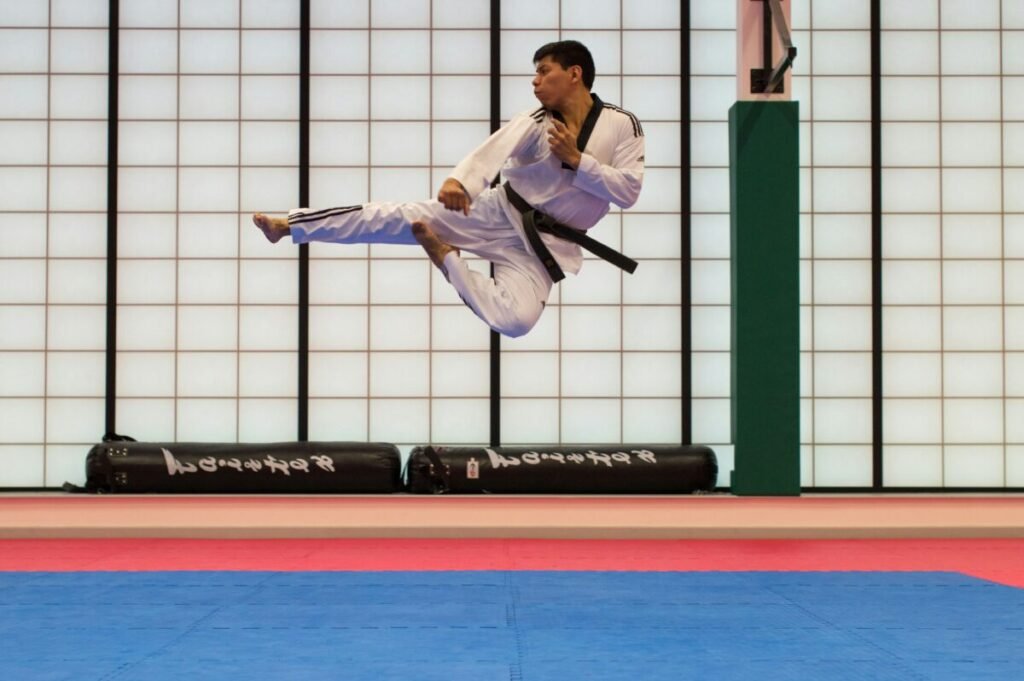
Taekwondo is a sport of high-velocity levers. When you whip a roundhouse kick into a heavy bag, you generate massive rotational force through your hips, knees, and ankles. If your alignment is off by even a few degrees, that kinetic energy does not just evaporate. It rebounds directly into your connective tissue.
In my experience training over 25,000 students, “freak accidents” are rare. Most injuries are the final breaking point of a bad habit ignored for months. Let’s address the usual suspects:
- The Ankle: This joint takes a beating during pivoting. If your supporting foot does not rotate fully on the ball of the foot, the ankle joint twists instead of the hip doing the work. Landing awkwardly from a jump kick is a classic recipe for a sprain.
- The Knee: The knee is a hinge joint, meant to bend forward and back. It is not designed to twist under load. If your foot is planted and you torque your hips without allowing the foot to pivot, you risk meniscus tears and ligament strains. Always ensure the foot follows the hip line.
- The Hip Flexors: We spend hours kicking, which shortens these muscles, and then we sit at desks, which tightens them further. Without targeted mobility, those tight hip flexors will eventually pull on your lower back, creating chronic discomfort.
- The Lower Back: This area is usually the victim of a weak core. If your abdominal muscles aren’t braced during a spinning hook kick, your lumbar spine absorbs the entire rotational whip. That is when sharp, stabbing pains occur.
The Pre-Training Ritual: Waking Up the Nervous System
A cold muscle is essentially a brittle rubber band. Walking into the dojo, dropping your bag, and immediately attempting a head-height target is a fast track to a tear. Your body requires a systematic shift from “desk mode” to “explosive athlete.” At our Jaipur studio, we do not just stretch; we prep the nervous system.
| Phase | What You’re Actually Doing | Examples to Try |
|---|---|---|
| General Warm-up | Raising core temperature and circulating synovial fluid in the joints. | Light jogging, skipping rope, shadow boxing. |
| Dynamic Mobility | Taking joints through their full range of motion under control. | Leg swings, lateral lunges, controlled torso twists. |
| Specific Activation | Waking up prime movers so they fire correctly during class. | Glute bridges, bodyweight squats, plank holds. |
Ditch the static stretching before class. Holding a deep hamstring stretch for 60 seconds temporarily weakens the muscle and dulls your explosive power. Save those long, deep holds for after class when your muscles are warm and you are shifting into recovery mode.
Technical Precision: Let Physics Do the Heavy Lifting
There is a massive misconception among white and yellow belts that power comes from kicking as hard as humanly possible. It does not. Real power in Taekwondo is a byproduct of speed, relaxation, and perfect mechanical efficiency.
Consider the “snap” of a roundhouse kick. If you tense your entire leg before impact, you are fighting your own muscle contractions. You want to remain fluid until the millisecond of contact. We often see students use their lower back to compensate for a lack of hip rotation. If you feel a pinch in your lower lumbar region after practice, it is a red flag that your hips are locked.
You must learn to “listen” to your joints. If you feel a pinch in your knee when you pivot, stop. Check your foot position. Often, rotating your supporting foot another two inches changes the load distribution, saving your knee and actually increasing your kick speed. We hammer this into our students: fifty technically perfect kicks build a much better fighter—and a much healthier body—than two hundred sloppy, ego-driven reps.
The Injury Recovery Blueprint: What to Do When You Actually Get Hurt
Even with perfect form, martial arts is a contact sport. You will get bruised. You might sprain an ankle or tweak a muscle. The old-school advice was just “rest and ice.” Modern sports science tells us that complete inactivity often slows down healing. Here is a protocol for when you are sidelined, designed to get you back on the mat faster.
Phase 1: The Acute Stage (First 48-72 Hours)
Right after an injury, your body’s inflammatory response kicks into overdrive. Manage it, do not suppress it entirely.
- Protect and Compress: Stop training the injured area immediately. Use a compression sleeve to limit excessive swelling.
- Elevate: Keep the limb above your heart when resting to assist fluid drainage.
- Ice vs. Heat: Use ice for the first couple of days to numb pain, but do not overdo it. You need some blood flow for the repair process to begin.
Phase 2: Active Rehab (Motion is Lotion)
Once the sharp pain subsides, introduce movement. Blood flow is the ultimate medicine; it brings nutrients to damaged tissue and carries away metabolic waste.
- Isometric Holds: If moving the joint hurts, flex the muscle without moving the joint. For a bad knee, straight-leg raises or wall sits keep the quads strong without grinding the joint.
- Band Work: Use light resistance bands to gently take the joint through its range of motion. This rebuilds the neurological connection between your brain and the injured muscle.
- Train Around the Injury: Hurt your right ankle? Use the time to train your core, improve left-legged balance, or work on upper-body conditioning. Do not let one injury stop your entire progress.
Phase 3: The Re-integration
This is where most students re-injure themselves. They feel 90% better, jump back into full sparring, and tear the muscle again. Scale your return. Start with shadow kicking. Move to the heavy bag at 50% power. Only when you can throw the technique pain-free at full speed should you consider sparring.
The Invisible Training: Sleep, Nutrition, and the Nervous System
You do not build muscle or repair tendons while you are sweating in the dojo. You build them while you sleep. If you train hard five days a week but only sleep five hours a night, you are digging a recovery hole you cannot climb out of.
Think of your body like a high-performance vehicle. You wouldn’t drive a sports car 200 kilometers per hour without changing the oil or checking the tires. Your nutrition is that oil. Prioritize high-quality protein—lean meats, lentils, or eggs—to repair the micro-tears in your muscle fibers. Include anti-inflammatory foods like turmeric, ginger, and leafy greens. Dehydrated fascia—the connective tissue wrapping your muscles—becomes “sticky” and restricts movement, leading to unnecessary pulls. Drink at least three liters of water daily, especially here in the dry heat of Rajasthan.
Ego vs. Longevity: The Mental Game of Injury
This is often the hardest pill to swallow. A lot of injuries happen because of ego. You feel a twinge in your shoulder, but you do not want to look weak in front of a sparring partner, so you throw one more heavy punch. That is how a minor strain becomes a six-month tear.
At Om’s, we believe in Discipline Over Motivation. True discipline is not just pushing through pain; it is having the maturity to tap out, grab a foam roller, and perform your rehab exercises while others are sparring. Separate your self-worth from your daily output. Resting is training. If you cannot perform a technique safely, you have not “failed”—you have successfully identified a weakness that now requires a targeted solution.
Adapting the Art to the Athlete (Kids vs. Adults)
A 12-year-old’s body is a completely different machine than a 45-year-old’s. Kids are incredibly flexible but often lack joint stability and bone density. For them, injury prevention focuses on teaching spatial awareness, balance, and ensuring they aren’t hyperextending their joints during kicks. We emphasize landing mechanics; teaching a child how to fall or land a kick properly prevents trauma to the growth plates.
Adults, conversely, usually possess the mental discipline but often lack the mobility. We focus heavily on strength training outside of class. Building strong glutes, hamstrings, and a bulletproof core acts like internal armor for your lower back and knees. If your muscles are too weak to absorb the shock of a landing, your joints will take the hit instead. I often tell my adult students: “You are not training to be an Olympian today; you are training to be a healthy, functional human for the next thirty years.”
Building a Bulletproof Training Habit
Consistency will always beat intensity. If you train at 80% effort but never miss a week, you will eventually surpass the person who goes 110% for a month and then spends the next two months on the couch with a torn hamstring.
Your Pre-Class Mental Checklist
- Did I actually warm up, or did I just walk in and start stretching?
- Is my gear in good shape? Frayed shin guards or loose foot protectors can lead to poor movement habits.
- Am I focused on the quality of my technique, or just trying to hit the bag as hard as possible?
- Is my ego in check? Am I willing to scale back if my body feels off?
- Do I have my post-class plan ready? Hydration, protein, and a good night’s sleep are non-negotiable.
Martial arts is a lifelong pursuit. It should make you stronger, more capable, and more resilient—not broken and sidelined. By respecting the biomechanics of your body, taking your rehab seriously, and checking your ego at the door, you guarantee that your time on the mat remains a source of empowerment for decades. We are here at Om’s Martial Arts & Fitness Studio to guide you through every step of that process. Train smart, recover harder, and we will see you on the mat. Empowering Jaipur and India through Martial Arts, Fitness & Self-Defense.