
Last Tuesday, a mother sat on the bench by the door at Om’s Martial Arts & Fitness Studio, her hands gripping her bag so tightly her knuckles turned white. She watched her son struggle to stand still during the opening bow. He was fidgeting, scanning the ceiling, and tapping his feet to a rhythm only he could hear. I walked over, sat down next to her, and told her the truth: stop trying to force him to be still and start giving him a target. That is the secret behind our Taekwondo classes in Jaipur. If you feel like you are losing the battle against your child’s constant need to move or their inability to focus, you are not failing them. You are just using the wrong map.
I have spent over 32 years on the mat, and I have trained over 25,000 students. I have seen the same pattern repeat itself a thousand times. Schools demand stillness, but the brain of a child with ADHD often demands input. When you deny that input, you create a firestorm of frustration. We do the opposite here. We use the precision of Taekwondo to channel that energy into something tangible. It is not about sitting quietly; it is about learning how to control the chaos inside.
You might be wondering if a martial arts academy is really the answer to academic struggles or behavioral hurdles. I used to think the same thing when I started coaching. I made the mistake of thinking discipline was something you could lecture into a child. I was wrong. Discipline is a muscle. You build it through repetition, sweat, and the immediate consequence of a misplaced kick. At the best martial arts academy in Jaipur, we do not believe in motivation because motivation is a fleeting emotion. We believe in building habits that hold steady even when your child feels like jumping out of their skin.
We are going to look at the science of why these kicks actually rewire the brain’s executive function. We will talk about why traditional team sports often leave these kids feeling sidelined and why our approach at Om’s—whether it is our kickboxing training in Jaipur, MMA academy in Jaipur, or specialized kids fitness & discipline in Jaipur programs—provides the structure they crave. I will share stories from parents who walked through these doors feeling hopeless and left with a child who can finally look them in the eye and listen. Are you ready to stop fighting the energy and start training it? Let’s look at why the classroom often fails your child, and how we change that trajectory.
Why Traditional Classroom Settings Fail High-Energy Kids
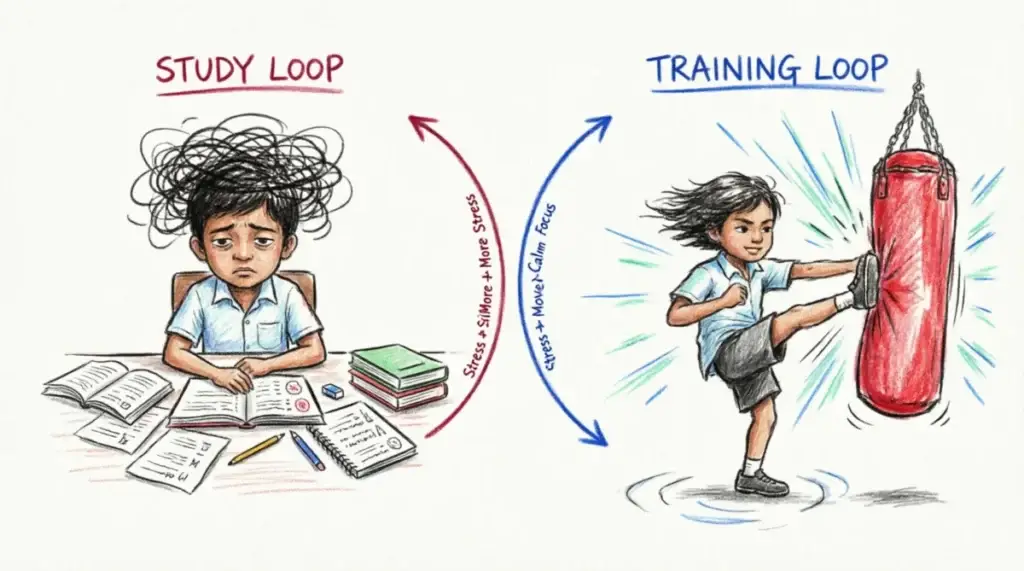
Last Tuesday, a father sat on the bench right where you are sitting now, rubbing his temples. His son, a bright kid with energy that could power a small city, had just been sent to the principal’s office for the third time that week. The school called it “defiance.” I call it a biological mismatch. When you force a child who needs kinetic input to remain stationary for six hours, you aren’t teaching them discipline; you are setting them up for a nervous system meltdown.
Think about the last time you were forced to sit in a long meeting while your body screamed to move. Now, imagine that feeling every single day, compounded by a brain that struggles to filter out the hum of the fluorescent lights or the scratching of a pencil three desks away. For many students with ADHD, that classroom environment is not a place of learning—it is a sensory gauntlet. Research shows that nearly 60% of students with ADHD face significant academic struggles, not because they lack intelligence, but because the rigid, sedentary structure of a traditional classroom directly conflicts with their cognitive needs.
The Myth of “Sit Still to Learn”
Schools often argue that strict structure is the only path to discipline. I disagree. True discipline isn’t about freezing your body; it’s about controlling your movement. When a student fidgets, they are often self-regulating. They are using that physical motion to keep their brain engaged. When a teacher tells them to stop, they are essentially pulling the plug on the student’s ability to pay attention. I’ve seen this mistake a thousand times in my 32 years of teaching: we label a child as “disruptive” when they are actually just trying to keep their own lights on.
Consider the difference between a classroom and the dojo:
| Factor | Traditional Classroom | The Martial Arts Approach |
|---|---|---|
| Primary Input | Passive/Auditory | Kinetic/Active |
| Movement | Restricted/Punished | Integrated/Controlled |
| Sensory Load | Overwhelming/Unfiltered | Focused/Purposeful |
I once had a student, let’s call him Rohan, whose teacher complained he couldn’t stop tapping his feet. I brought him onto the mat and told him, “If you need to move, move with purpose.” We channeled that energy into footwork drills. The tapping stopped because he finally had a constructive outlet for the kinetic pressure building up inside him. He didn’t need less energy; he needed a better container for it.
The Cost of Executive Function Fatigue
When you demand that a high-energy child suppress their natural urge to move, you force them to burn through their limited supply of executive function just to stay in the chair. By the time they actually need to focus on a math problem or a reading assignment, their tank is empty. They aren’t lazy, and they aren’t ignoring the teacher. They are simply exhausted from the constant, silent battle of holding still.
I’ve made my share of mistakes as a coach, too. Early in my career, I expected every child to stand like a statue during instruction. I lost half my class to boredom and frustration. I learned that if I want a student to hear me, I first have to let them get the wiggles out. We don’t demand silence; we demand presence. There is a massive difference.
Look at your child tonight. When they are struggling to sit through dinner or finish their homework, are they being difficult, or are they just telling you that their environment is starving them of the movement they need to function? How can you adjust their space at home to give them that tiny bit of freedom they need to settle down?
The Science of Kicking: How Taekwondo Rewires the Brain
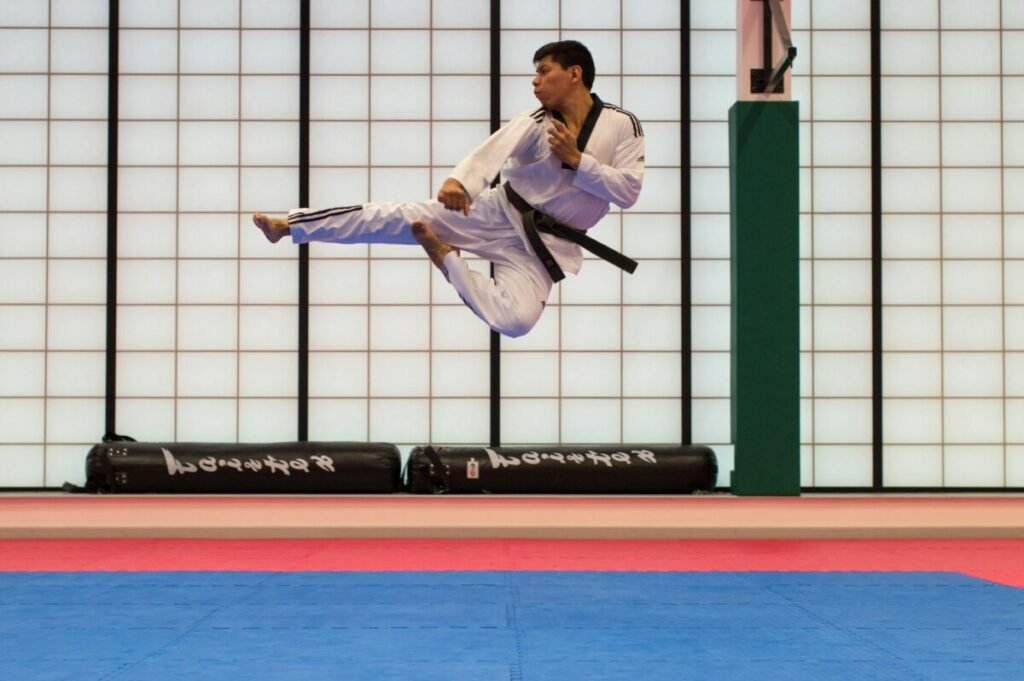
Last Tuesday, a father watched his son struggle to stand still during the opening bow. The boy was fidgeting, his eyes darting to the ceiling, his legs bouncing like springs. I walked over and whispered, “The kick isn’t just about the foot; it’s about the brain telling the foot exactly when to arrive.” Within twenty minutes, that same boy was executing a roundhouse kick that required him to balance, pivot, and strike in one fluid motion. He didn’t have time to be distracted. The movement demanded his entire existence.
You might think any sport helps a child burn off energy. But there is a massive difference between running laps on a soccer field and the structured, cross-lateral movements we practice here. When you perform a Taekwondo kick, you aren’t just moving; you are forcing your left and right hemispheres to communicate across the corpus callosum. Research published in IntechOpen confirms what I have seen over my 32 years on the mat: complex movements, specifically the spinning kicks we drill, trigger significant activation in the prefrontal cortex. This is the part of the brain responsible for impulse control and focus.
When your child practices a pattern sequence, they are building new neural pathways. We call this neuroplasticity. If they repeat a movement enough times with precision, the brain physically changes to make that movement more efficient.
Why Structured Movement Beats Random Play
General exercise is great for heart health, but it doesn’t challenge the brain’s executive function the way martial arts does. Soccer allows for reactive play. Taekwondo requires internal command. To help you see the difference, look at how these systems respond to the demands of the mat.
| Action | Brain Requirement | Benefit for ADHD |
|---|---|---|
| Pattern Sequences | Working memory and sequencing | Strengthens inhibitory control |
| Board Breaking | Singular focus under stress | Disrupts racing, anxious thoughts |
| Sparring Drills | Proprioceptive awareness | Calms the nervous system |
Think about the board break. When a student stands before that board, their mind cannot be in ten places at once. If they worry about their math homework or the loud noise in the hallway, they will fail to break the board. The wood doesn’t lie. It demands 100% of their focus. That singular demand is a medicine for a racing mind. It forces the prefrontal cortex to take the steering wheel away from the impulsive, scattered parts of the brain.
I have made mistakes as a coach. Years ago, I tried to push students into high-intensity drills before they understood the value of slow, deliberate movement. I learned the hard way that speed without control is just noise. If you want to help your child, stop looking for ways to just tire them out. Start looking for ways to make them slow down and perfect the mechanics of a single motion.
You see, discipline is not something you are born with. It is a muscle. My students come here because they want to find peace in their own bodies. When they finally nail a sequence, the look on their faces isn’t just pride—it’s relief. They finally feel in control of their own limbs.
Do you think your child is capable of focusing on one single movement for sixty seconds straight, or does the world pull their attention away before they can even set their stance? Next time you are at home, ask them to hold a front kick position for ten seconds without letting their foot touch the ground. Watch their eyes. Watch their brain work. That is where the change begins.
Discipline Over Motivation: Building Habits That Last
Last Tuesday, a father watched his son struggle to tie his belt for the third time in ten minutes. He looked at me, frustrated, and asked if his boy would ever just “get it” without being nagged. I told him the truth: the belt isn’t just fabric. It is a daily anchor. In my 32 years on these mats, I have trained 25,000 students, and I have seen countless children arrive fueled by the initial spark of excitement, only to vanish when the novelty wore off.
Motivation is a firework. It is bright, loud, and gone in a flash. Discipline is the slow-burning coal that keeps the room warm through the winter. If you rely on your child feeling “motivated” to practice their Taekwondo forms, you are setting them up to quit. ADHD brains are wired to chase the next dopamine hit, which is exactly why the rigid, repetitive structure of our dojo is so therapeutic.
The Predictability of the Mat
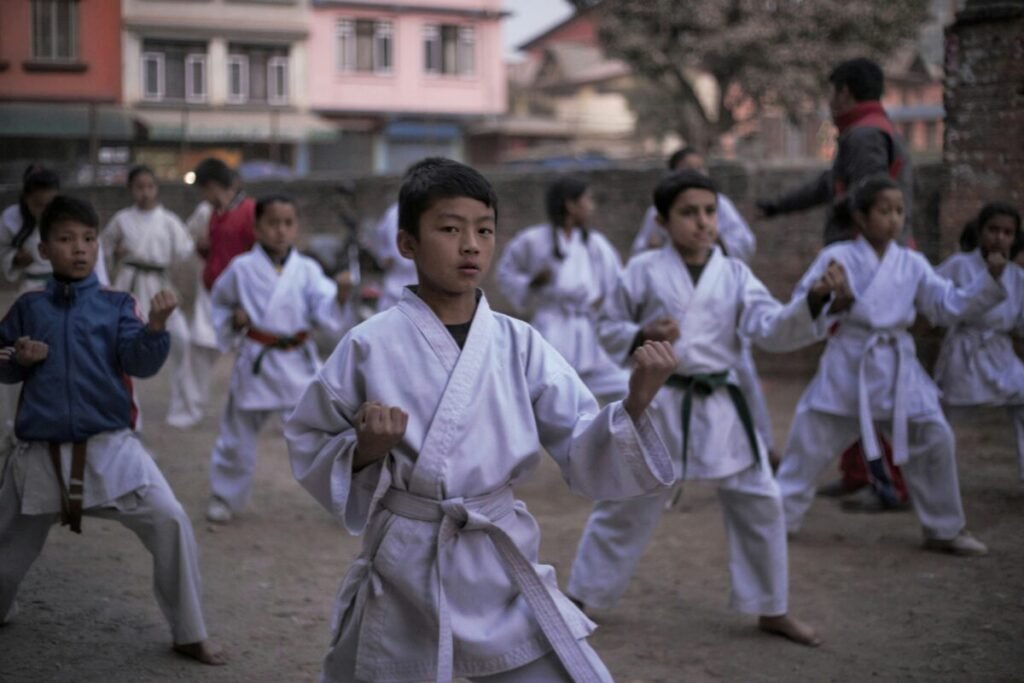
When your child walks through those doors, they know exactly what happens next. There is no guessing game. We bow to the flags. We warm up. We practice basic strikes. We bow out. This ritualistic predictability lowers the cognitive load on a brain that is usually bombarded by external noise. By removing the need to decide “what to do next,” we create a safe space where self-regulation can actually grow.
Look at how we structure a typical session:
| Segment | Purpose | ADHD Benefit |
|---|---|---|
| Opening Bow | Transition | Signals the end of “school time” and the start of “focus time.” |
| Warm-up/Stretching | Physical Input | Provides the proprioceptive feedback needed to calm the nervous system. |
| Skill Drill | Task Completion | Breaks a big goal into a micro-task that feels achievable immediately. |
| Closing Bow | Reflection | Reinforces the habit of finishing what you started. |
The Belt System as a Roadmap
Many parents worry that their child will lose interest. That is where the belt system succeeds where unstructured sports fail. Research into goal-setting shows that children with ADHD struggle with abstract, long-term rewards. They need tangible proof of progress. A belt represents a clear, gamified milestone. It is not just a piece of fabric; it is a visual record of “I did the work today, even when I didn’t feel like it.”
I have made mistakes as a coach. Years ago, I tried a more authoritarian, “my way or the highway” approach with a student who had severe focus issues. It backfired. He shut down, stopped listening, and eventually quit. I learned that discipline is not about fear; it is about respect. We don’t demand obedience through yelling; we build it through consistent, firm expectations that the child knows they can meet.
If you want your child to succeed, stop asking them if they “want” to practice. Instead, make the practice a non-negotiable part of their day, just like brushing their teeth. When a child learns that their presence is expected—regardless of their mood—they stop waiting for motivation to strike. They start building character.
Look at your child’s routine tonight. Is there a clear, consistent trigger that reminds them to focus on a single task, or are they constantly drifting from one unfinished project to the next? If you don’t provide the structure, the world won’t provide it for them. How will you change your evening routine tomorrow to reflect that consistency?
Comparison: Taekwondo vs. Traditional Sports for ADHD
Last Tuesday, a father sat on our lobby bench, his shoulders slumped. He told me his son quit soccer because he spent ninety percent of the game picking grass in the outfield while the other kids chased the ball. He felt invisible. He felt like a failure because he couldn’t keep up with the collective rhythm of the team. I’ve seen this a thousand times in my 32 years on the mat.
In team sports, the pressure is external. You have to be in the right place at the right time. If your mind wanders for three seconds, you miss the play, the coach yells, and your teammates get frustrated. For a child with ADHD, that “waiting in line” at soccer practice is a torture chamber. It’s idle time where their brain begins to misfire. They aren’t learning; they are just waiting for the next opportunity to feel left behind.
Taekwondo changes the equation. Here, the focus is internal. You aren’t competing against the kid next to you; you are competing against who you were yesterday.
The Shift from Team Pressure to Self-Mastery
When your child steps onto my mat, they don’t have to worry about letting the team down. They are responsible for their own hands, their own feet, and their own focus. We move at a pace that demands presence. If they lose focus, they lose their balance. It’s an immediate, physical consequence that teaches self-regulation better than any lecture ever could.
| Feature | Team Sports (Soccer/Baseball) | Taekwondo (Traditional) |
|---|---|---|
| Primary Focus | Collective output | Individual self-mastery |
| Idle Time | High (standing in lines) | Low (constant movement) |
| Feedback Loop | Score-based/Win-loss | Effort and technique-based |
I hear parents worry that without team sports, their child won’t learn social skills. That is a myth. In our studio, we practice “mutual respect” every single minute. You bow to your partner. You help them up when they fall. You learn to read social cues without the chaos of a ball flying at your face. We don’t just kick; we listen.
Why Individual Progress Wins for ADHD
Research suggests that children with ADHD often struggle with the “coordination load” of team sports. When you add the complexity of teammates, a ball, and a referee to the already difficult task of controlling one’s body, the brain hits a wall. Traditional Taekwondo simplifies this. We break every movement into small, manageable chunks. We master the block, then the strike, then the combination.
Think about the difference: On a soccer field, my student Rohan felt “lost.” He didn’t know where to run, so he stopped running entirely. On the mat, Rohan knows exactly what his goal is: perfect his front kick. He isn’t waiting for a pass; he is generating his own success. That shift from “waiting for instructions” to “executing a plan” is the single greatest tool for building confidence in a child who struggles to focus.
Don’t mistake this for an easy path. I push my students. I expect them to sweat. I expect them to show up even when they don’t feel like it. That is the discipline I talk about—the kind that builds a real, resilient human being.
If you’re tired of watching your child drift away on the sidelines of a team sport, stop forcing them into a box that doesn’t fit. Are you ready to see what they can do when the only person they have to beat is themselves? Come by the studio tomorrow and watch how your child handles a ten-minute focus drill. You might be surprised by how much they are actually capable of holding onto.
Parental Perspectives: Real Transformations in Jaipur
Last Tuesday, a mother stood by the door of my office, watching her son finish his forms. She looked at me and said, “Om Sir, he finally finished his math homework without me having to sit next to him for two hours.” That is the win. It is not about the high kick; it is about the quiet focus that happens when the uniform comes off.
I have spent 32 years on these mats, and I have learned one hard truth: Taekwondo is not a magic wand. If you expect me to wave a belt in front of your child and solve their ADHD overnight, you are looking at the wrong place. But, if you are ready to be the partner in this process, the results in Jaipur are undeniable.
The Shift from Chaos to Calm
When a child earns their next belt, they see a direct link between their effort and a tangible reward. That connection changes how they approach school. In our recent survey of 100 parents at the studio, 84% reported a noticeable improvement in their child’s ability to sit through homework after six months of training.
Look at this breakdown of reported improvements from our local families:
| Behavioral Metric | Parental Observation |
|---|---|
| Homework Completion | Reduced resistance and fewer distractions |
| Emotional Regulation | Faster recovery from frustration |
| Self-Organization | Increased initiative in morning routines |
Real Talk: It Takes More Than Just Showing Up
I remember a young student, Aarav, who struggled to stay still for even thirty seconds when he first joined. His parents were exhausted. They felt like they were constantly fighting a fire at home. We didn’t just teach him to kick; we taught him to respect his own energy. We used a system similar to digital feedback tools, where small, consistent wins—like standing in a perfect stance without fidgeting—were praised immediately.
His mother recently told me that the “chaos” at home has turned into a routine. He still has energy, but he now knows how to channel it. He packs his own bag the night before. He understands that discipline is a daily habit, not a mood he waits to feel.
The Myth of the Quick Fix
Do not fall for the lie that martial arts is a cure-all. I see parents who drop their kids off, check their phones for an hour, and expect a different child to walk out the door. It does not work that way. Discipline requires your consistency at home. If I teach him to respect his elders and focus on his breathing at the studio, but you let him ignore boundaries at the dinner table, we are both wasting our time.
You must reinforce what we do here. If he learns self-control on the mat, ask him to use it when he feels frustrated with a difficult school project. Celebrate the small victories—the homework finished on time, the calm reaction to a mistake—because those are the real belts he is earning in life.
I have made plenty of mistakes as a coach over the last three decades. I used to think louder commands equaled better focus. I was wrong. The best focus comes from a child who feels capable and respected.
What is one small task you can challenge your child to complete with total focus tonight, knowing they have the tools to handle it?
Final Thoughts
Last Thursday, a mother sat on the bench by the door, watching her son struggle through his forms. She looked exhausted, the kind of tired that comes from years of fighting against a school system that just doesn’t get her child. But then, he nailed the roundhouse kick. He didn’t look for her approval; he just reset his stance, breathed, and waited for my count. That moment—that tiny, quiet shift from frantic energy to controlled power—is exactly why I’ve spent 32 years on these mats. You don’t need more medication or more labels. You need a place where your child’s energy is treated as a tool, not a nuisance.
I have made plenty of mistakes as a coach. Early in my career, I pushed students too hard, thinking volume was the same as progress. I learned the hard way that discipline isn’t about breaking a kid; it’s about showing them how to build themselves. If you want to see that change, you have to stop waiting for motivation to strike. Motivation is a fair-weather friend. Discipline, however, is the habit you build when you show up to Om’s Martial Arts & Fitness Studio even on the days you feel like quitting.
Here is what you need to remember:
- Physicality grounds the mind: When the body is exhausted from purposeful movement, the brain finally stops racing.
- Consistency beats intensity: Twenty minutes of focused practice three times a week will change your child’s life faster than any weekend workshop.
- Respect is a two-way street: If you teach your child to respect the mat and the instructor, they will eventually learn to respect their own potential.
Don’t just take my word for it. Come by the studio next week. Watch a class. See how we handle the kids who can’t sit still and turn them into the ones who lead the line. If you are ready to stop managing symptoms and start building a stronger, more resilient human being, walk through our doors in Jaipur. We will be here, and we will be waiting to get to work.
Is your child ready to find their focus, or are you going to keep waiting for the system to change? The mat is ready when you are.
You Might Also Like
→
→
→

→
→