
Last Tuesday, a father sat on the bench in my office, his head in his hands, telling me his son had been sent home from school again for not staying in his seat. He looked at me and asked, “Om Sir, is there any hope for a kid who just cannot stop moving?” I didn’t reach for a textbook. I looked him in the eye and told him exactly what I tell every parent who walks into Om’s Martial Arts & Fitness Studio: your son isn’t broken, he is just running on a frequency the classroom doesn’t know how to tune into. We see this every single day here, and frankly, I see a future black belt standing in front of that restless energy.
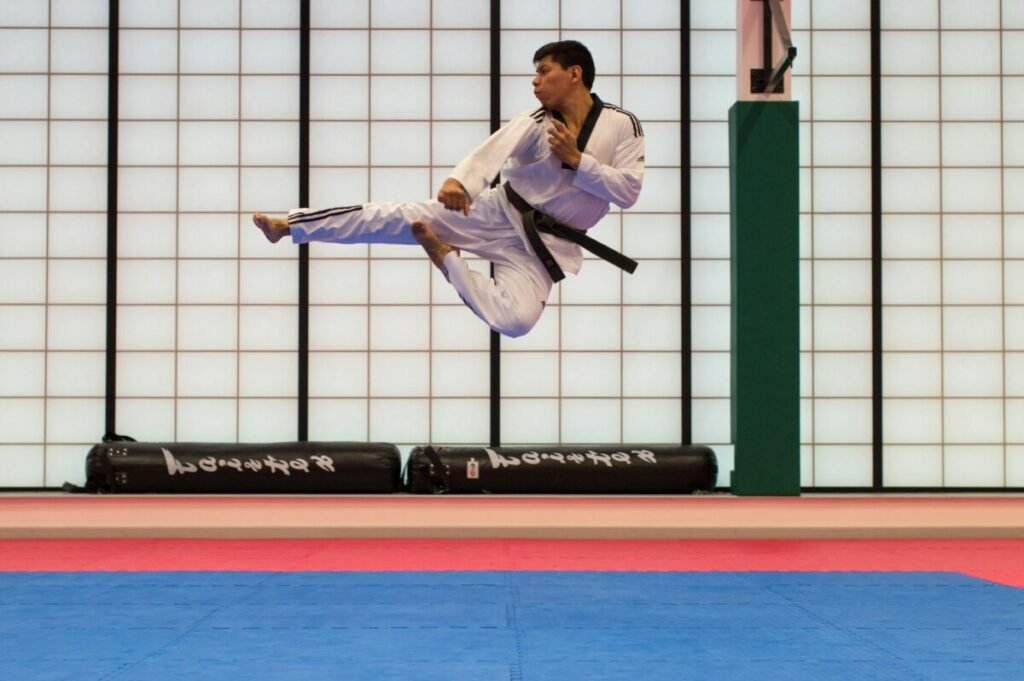
You have likely tried everything—extra homework hours, strict reward charts, maybe even medication—but the school desk remains a prison for your child’s brain. You see the frustration mounting, and you wonder if they will ever find a way to channel that intensity into something productive. Here is the hard truth: discipline is not something you lecture into a child. You build it through the sweat of the best martial arts academy Jaipur has to offer. When a child learns to balance on one leg while throwing a clean side-kick, they aren’t just learning a move; they are training their brain to pause, process, and execute. This is the physiological reset that so many high-energy kids are starved for.
I have spent 32 years teaching, and I have made plenty of mistakes along the way. I used to think yelling louder made a student listen better. I was wrong. I learned that true focus comes when a child finds a goal they actually care about, not when they are forced to sit still for six hours a day. We move beyond standard Taekwondo classes Jaipur routines because your child needs more than just exercise; they need a system that maps their brain to their movements. We are going to look at why that classroom chair is the wrong tool for the job, how the specific patterns of our training rewire a child’s attention span, and exactly how we turn that “disruptive” energy into pure, focused power.
Do you believe your child is capable of sitting still if the challenge is actually worth their time? Let’s look at why the school system misses the mark while the mat changes everything.
Why Traditional Classroom Settings Fail High-Energy Kids
Last Tuesday, a father sat on our lobby bench, his head in his hands. His son, a bright ten-year-old, had just received another “restless” report from his school teacher. The boy isn’t a troublemaker; he just has a brain that refuses to idle. I looked at that father and told him the truth: the school system wasn’t designed for his son’s biology. It was designed for a factory floor, where silence and stillness are the primary metrics of success.
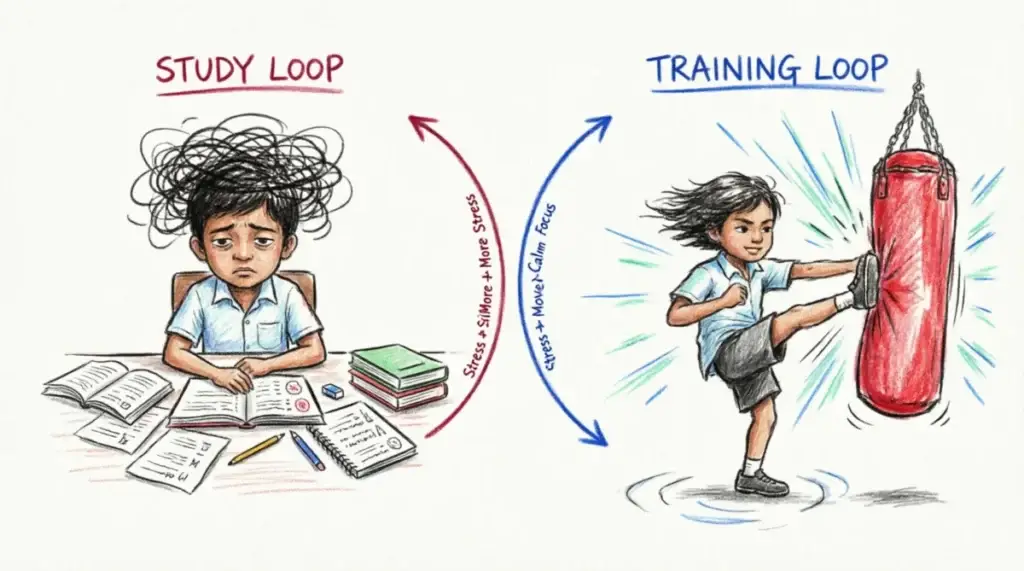
When we look at the research from places like the Child Mind Institute, we see that ADHD isn’t just about being “hyper.” It is a neurodevelopmental reality that demands a specific environment to function. In a standard classroom, your child is expected to sit at a desk for hours. For an ADHD brain, that desk is a cage. The dopamine-seeking nature of a child with focus issues means they are constantly scanning for stimulation. When the teacher’s voice drones on and the environment is static, the brain effectively goes “offline” to find its own entertainment. It starts tapping a pencil, drifting to the window, or engaging in impulsive movements.
Think about the mismatch here. We ask these kids to perform executive functions—planning, organizing, and controlling impulses—while simultaneously stripping away the movement they need to regulate their nervous systems. Data from studies on classroom settings shows that when kids with ADHD are forced into long stretches of individual seatwork, their “active learning engagement” plummets, while “classroom restlessness” skyrockets. It isn’t a lack of discipline. It is a biological mismatch.
The Classroom Struggle: A Comparison
| Setting Type | ADHD Brain Response | Result |
|---|---|---|
| Static Desk Work | Dopamine starvation | Internal “noise” grows, leading to fidgeting. |
| Movement-Based Learning | Dopamine regulation | Increased focus and physical calm. |
| High-Structure/Low-Stim | Feeling “trapped” | Emotional regression or shutdown. |
I remember a student we had a few years back, Aarav. In his primary school, he was labeled “disruptive” because he couldn’t stop getting up to sharpen his pencil or organize his desk. His sensory processing was overloaded by the constant, low-level buzz of thirty other kids sitting still. When he came to my dojo, he was the same boy—same energy, same brain—but the setting had changed. Here, we don’t ask for stillness; we ask for *directed* movement. We replaced the “sit down and listen” command with “get into a front stance and hold it.”
Some people will tell you that ADHD kids need a low-stimulus, high-structure environment to “calm down.” That is a myth. If you put a high-energy child in a vacuum, you don’t get peace; you get a pressure cooker waiting to explode. They don’t need less stimulation; they need *productive* stimulation. They need a place where their effort is measured by the sweat on their brow rather than the stillness of their chair.
I’ve spent 32 years on these mats, and I’ve seen 25,000 students pass through my doors. I have made the mistake of pushing a child to sit still when they needed to move, and I have paid for it with their frustration. Discipline isn’t about crushing their energy; it’s about giving that energy a roadmap. If your child is struggling in school, don’t blame their character. Look at the environment. Are we asking a racecar to park in a garage and wondering why it’s vibrating?
If you were to watch your child in their classroom tomorrow, what is the one specific moment where you see them start to “check out” or lose their grip on their self-control?
The Science of Kicking: Patterns, Repetition, and Brain Mapping
Last Tuesday, a mother watched her son struggle through a simple front-kick drill. He kept mixing up his left and right legs, his eyes darting toward the clock, his posture slumped. She asked me if he was just being difficult. I looked at her and said, “He isn’t fighting you; he’s fighting his own internal wiring.”
You see, in my 32 years on the mat, I’ve learned that the ADHD brain often craves order, even if it doesn’t know how to ask for it. When we teach Taekwondo, we aren’t just teaching a kid how to hit a target. We are forcing the left and right hemispheres of the brain to talk to each other.
When your child performs a cross-body block or a series of kicks, they are engaging in bilateral movement. Science calls this crossing the midline. It sounds technical, but it’s simple: every time your child reaches across their body to execute a technique, they force the corpus callosum—the bridge between the two brain hemispheres—to fire up. This communication is exactly what a scattered mind lacks. By strengthening these pathways, we move beyond just “learning a move.” We are literally building a better-connected brain. Research suggests that consistent martial arts practice actually increases grey matter density in the prefrontal cortex, the very area responsible for focus, impulse control, and planning.
Why Repetition Isn’t Just “Drill and Kill”
Some parents worry that the repetitive nature of poomsae (forms) will bore an ADHD brain. I’ve seen it happen. If I just stand there and tell a student to repeat a form ten times without purpose, they tune out. That is my failure as a coach, not theirs.
To keep the brain engaged, we gamify the repetition. We treat each form like a map. If they miss a step, the “map” doesn’t work. This requires them to slow down, visualize the movement, and track their own progress. It turns a boring task into a high-stakes puzzle.
| Traditional Drill | Our Gamified Approach |
|---|---|
| Repeat form 10 times | Beat your time from last session |
| Static stance holding | Hold until you can balance an object on your knee |
| Memorizing steps | Explain the “why” behind every move to a partner |
Mapping the Movement
Think of poomsae as a neural workout. When a student memorizes a sequence, they aren’t just memorizing kicks; they are mapping spatial awareness. They learn to track their own limbs in space, which improves proprioception.
- Neuromuscular Control: Linking breath to movement quiets the “noise” in the mind.
- Rhythm Precision: Counting out loud forces the brain to organize time, which is often a struggle for kids with ADHD.
- Visual Tracking: Keeping eyes fixed on a target during a complex pattern trains the brain to ignore distractions.
I’ve made plenty of mistakes as a coach. Early in my career, I pushed kids too hard without explaining the “why.” I thought discipline meant silence. I was wrong. Discipline is actually the ability to stay focused when you want to look away.
Your child might kick the air, miss the target, and get frustrated. That is not the end of the world. That is the moment where the brain decides to either give up or try again with more intent. Next time you’re at home, ask your child to show you their favorite form—but ask them to do it in slow motion. Watch their eyes. When they have to think about which foot moves next, they are building the very focus they need to succeed in school.
Can you commit to practicing just one pattern with them tonight, focusing entirely on the precision of the midline cross?
Beyond the Mat: Real Transformations from Jaipur Parents
Last Tuesday, a mother sat on the bench near the entrance, watching her son, Aarav, struggle to keep his hands still during a basic side-kick drill. She sighed, worried that his ADHD made him a distraction to the rest of the class. I walked over after the bow-out and told her something she didn’t expect: “He isn’t failing; he’s learning the hardest lesson of his life.” After 32 years of teaching, I know that real progress doesn’t happen when a child is perfect. It happens when they miss, reset, and try again without falling apart.
Parents often ask me if the behavior we see in the studio is just the Hawthorne effect—the idea that kids behave better simply because they are in a new environment under a watchful eye. I tell them to look at the report cards. When a child learns to wait for a command before moving, they aren’t just performing for me. They are building a neural pathway for impulse control that follows them into the classroom.
Take the case of a young student we’ll call Rohan. His parents were at their wits’ end regarding his focus during homework. They started tracking his completion rates after six months of consistent training at the studio. The results were not just anecdotal; they were measurable.
Tracking the Shift: Before and After
| Metric | Initial Assessment | After 6 Months of Training |
|---|---|---|
| Homework Completion | 40% (Frequent frustration) | 85% (Self-initiated) |
| Impulse Control | Low (Frequent interruptions) | High (Wait-time improved) |
This isn’t magic. It is the result of applying discipline over motivation. We teach students that the goal isn’t to be fast; the goal is to be precise. When Rohan’s parents started applying the same principle at home—insisting on finishing one task before starting another—the home-community connection became a bridge for his growth. As the Noah Webster Educational Foundation points out, social-emotional learning shouldn’t be siloed. If you let your child skip the hard work at home, my lessons on the mat will never stick. You are the coach at home, just as I am the coach here.
I have seen parents transform their own patience by mirroring the structure we use in the dojang. When you demand respect for the process, you stop rewarding the chaos. One father told me last week that he stopped “rescuing” his daughter every time she felt overwhelmed by her chores. Instead, he asked her to “breathe and reset,” the same phrase I use when a student loses their form. She finished the chore. It was the first time she hadn’t dissolved into a meltdown.
Do you want to see this change? Stop looking for a quick fix or a pill that solves everything. Start by holding them to the same standard at the dinner table that I hold them to on the mat. If they can bow to their partner, they can clear their own plate. It sounds simple, but consistency is the hardest thing for a parent to master.
Are you willing to let your child struggle for a moment so they can learn the grit required to succeed, or are you still clearing the path for them?
Comparing Activity Types: Where Taekwondo Wins
Last Tuesday, a mother sat in our lobby watching her son, a bright eight-year-old with boundless energy, struggle during a sparring drill. She whispered that he had quit soccer two months ago because he spent half the game picking grass while the ball was at the other end of the field. I told her the truth: he wasn’t lazy; he was just lost. In a sport like football, if you lose focus for ten seconds, the game continues without you. You might even feel like a burden to your teammates.
Taekwondo is different. There is no bench. Every child is active every single second of the class. If a student loses focus, they feel it immediately because their technique suffers or their partner waits for them. That is not a punishment; that is instant feedback. It forces the brain to stay present.
Many parents fear that choosing a martial art means sacrificing social skills. They worry their child will become a lone wolf. I have seen the opposite happen in my thirty-two years of teaching. Because we emphasize mutual respect and structured sparring, children learn to communicate through movement and shared struggle. They aren’t just standing next to each other; they are helping each other sharpen their kicks.
The Power of the Belt System
In team sports, progress often feels tied to the team’s record. If the team loses, the child feels they lost. In my studio, we focus on the individual. The belt system provides a visual, tangible map of progress. When a child with ADHD sees that their hard work this week translates directly to a stripe on their belt, the dopamine loop is immediate and healthy. It rewards consistency over raw talent.
Data suggests that individual martial arts often see lower dropout rates for neurodivergent children compared to high-pressure team leagues. Why? Because the pressure here is internal. You are only competing against the version of yourself you were yesterday.
| Feature | Team Sports (e.g., Soccer) | Taekwondo |
|---|---|---|
| Engagement | Intermittent (bench time) | Constant (active participation) |
| Accountability | Group-based | Individual |
| Goal Setting | Winning the match | Mastering the technique |
| Social Dynamic | Group collaboration | Mutual respect and partnership |
Why Consistency Trumps Motivation
I hear parents talk about “keeping their child motivated.” Forget motivation. Motivation is a fickle friend that disappears when it rains or when the child is tired. We teach discipline. When your son stands on the mat and executes a perfect roundhouse kick despite wanting to fidget, he is building a neurological pathway for self-control.
I made a mistake early in my career by trying to make classes “fun” at the expense of structure. I thought I needed to entertain them. I was wrong. These kids don’t need a clown; they need a clear path. They need to know exactly what is expected of them when they walk through those doors. When you remove the ambiguity of “what do I do now,” you remove the anxiety that often triggers ADHD-related behavioral spikes.
Look at your child tonight. Do they need to be part of a crowd that might ignore them, or do they need to be in a place where they are seen, counted, and held accountable for their own growth?
If you were to watch your child’s next practice, could you point to one specific thing they earned solely through their own effort, or are they relying on the collective performance of a team to feel successful?
The Om Sir Method: 32 Years of Character Development
Last Tuesday, a young boy with ADHD—let’s call him Rohan—stood on the mat trembling. He had missed a kick three times in a row, and the frustration was boiling over. He started to tear up, ready to quit. Most people would tell him to “just calm down” or threaten him with push-ups. I did neither. I walked over, knelt down, and had him focus entirely on the feeling of his lungs expanding. We didn’t talk about the kick. We talked about the breath. After sixty seconds of controlled, rhythmic breathing, his heart rate slowed. He looked at me, wiped his eyes, and landed the next kick perfectly.
That is the foundation of my method. After 32 years and training over 25,000 students here in Jaipur, I have learned that discipline isn’t about breaking a child’s spirit to make them compliant. It is about giving them the tools to command their own internal state.
Why Punishment Fails the Developing Brain
Punitive measures—yelling, extra laps, or shaming—only teach a child to fear the coach. They don’t teach a child how to regulate their own nervous system. When you use fear, you bypass the part of the brain responsible for problem-solving. My philosophy centers on positive reinforcement paired with high-intensity physical output. We demand excellence, but we build the capacity for that excellence through specific mindfulness techniques.
If you are wondering how we track the success of this approach, look at the numbers. We see a retention rate that far exceeds industry standards because students aren’t just memorizing forms; they are learning how to handle their emotions. Research from groups like the VIA Institute shows that 87% of people who integrate mindfulness with character strengths improve their ability to manage real-world problems. We see this daily.
| Traditional Approach | The Om Sir Method |
|---|---|
| Punitive (Fear-based) | Regulative (Skill-based) |
| Compliance focused | Character focused |
| Short-term suppression | Long-term self-regulation |
Building Independence, Not Dependency
Some parents worry that if their child relies on a coach to calm down, they will never learn to do it alone. This is a valid fear, but it misses the point of mentorship. In the beginning, I am their external regulator. I am the voice that tells them to breathe. I am the mirror that reflects their frustration back to them so they can see it objectively.
But my goal is to make myself obsolete. We teach techniques like the “three-minute breathing space” adapted from clinical mindfulness practices. We encourage them to practice this before homework, before a test, or when they feel that familiar itch to lash out. You want your child to be able to pause, observe their anger, and choose their action rather than being a slave to their impulses.
I made plenty of mistakes early on. I used to think louder was better. I thought strictness meant rigidity. I was wrong. I realized that the loudest student in the room is often the most insecure, and the quietest one is often the one holding back a storm.
You have to be the anchor for your child, but you cannot hold the rope forever. Your child needs to learn the weight of their own actions. Are you ready to stop managing your child’s emotions for them and start teaching them how to master their own? The next time your child hits a wall, instead of fixing it for them, ask them to take three deep breaths and tell you what they feel in their chest. Can they do that for you tonight?
Final Thoughts
Last Tuesday, a father sat on the bench by the door, watching his son struggle to land a basic front kick. The boy was distracted, his eyes darting to the clock, his feet shuffling out of rhythm. I walked over, placed a hand on his shoulder, and reminded him that the floor doesn’t care about his distraction; it only cares about his intent. We adjusted his stance, focused on his breathing, and suddenly, he landed it. The look of pure, unadulterated pride on his face? That is why I have spent 32 years on these mats. I have made plenty of mistakes as a coach—rushing students who needed time, or pushing for form when they needed encouragement—but I learned that discipline isn’t about forcing a child to be still. It is about giving them a physical anchor for their racing minds.
You might be wondering if your child can handle the rigors of our training. My answer is simple: they don’t need to be perfect to start, they just need to show up. We don’t demand robots; we build humans who understand how to control their own energy. If you are tired of hearing that your child “can’t sit still,” stop trying to change their biology and start changing their environment. Give them a place where movement is the language, and focus is the prize.
Consider these truths as you decide your next move:
- Consistency creates clarity. Your child learns that their brain functions better when they commit to a specific pattern, not when they scatter their focus across five different distractions.
- Physicality builds the bridge to mental control. When they learn to coordinate a kick, they are literally wiring their brain to execute complex, multi-step instructions.
- Discipline is a habit, not a trait. You aren’t born with it. You build it, one sweat-drenched, repetition-heavy training session at a time.
At Om’s Martial Arts & Fitness Studio, we don’t just teach kicks. We provide the structure that allows a high-energy child to find their own rhythm. If you are ready to see what your child is actually capable of, bring them to our studio in Jaipur this week. Let them step onto the mat. Let them fail, let them fix it, and let them grow. Are you ready to see them stand a little taller, look you in the eye, and finally control that boundless energy? Come see me. Let’s get to work.
You Might Also Like
→
→
→

→

→