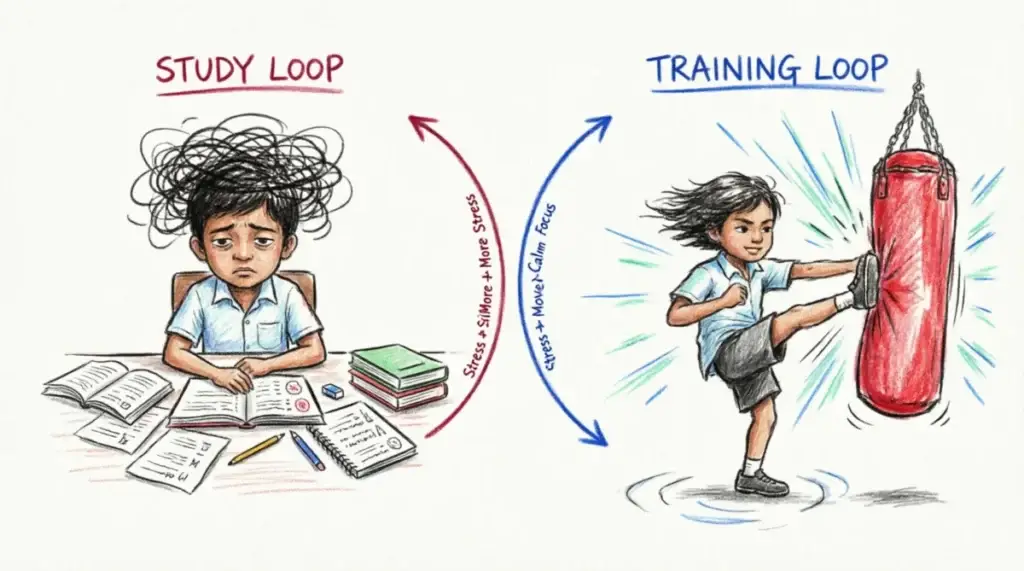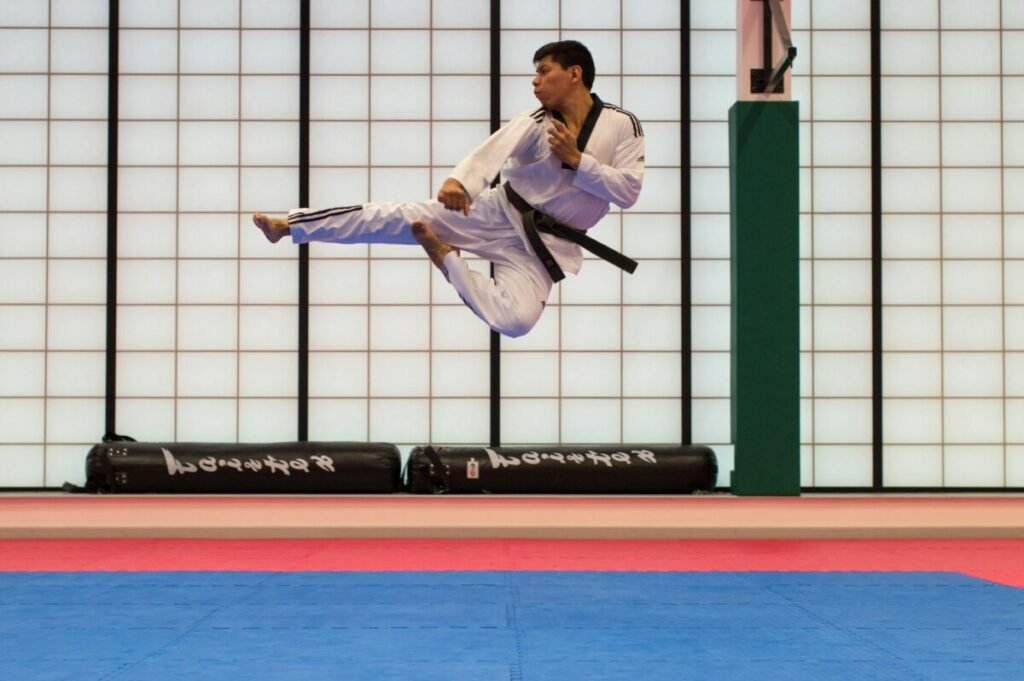
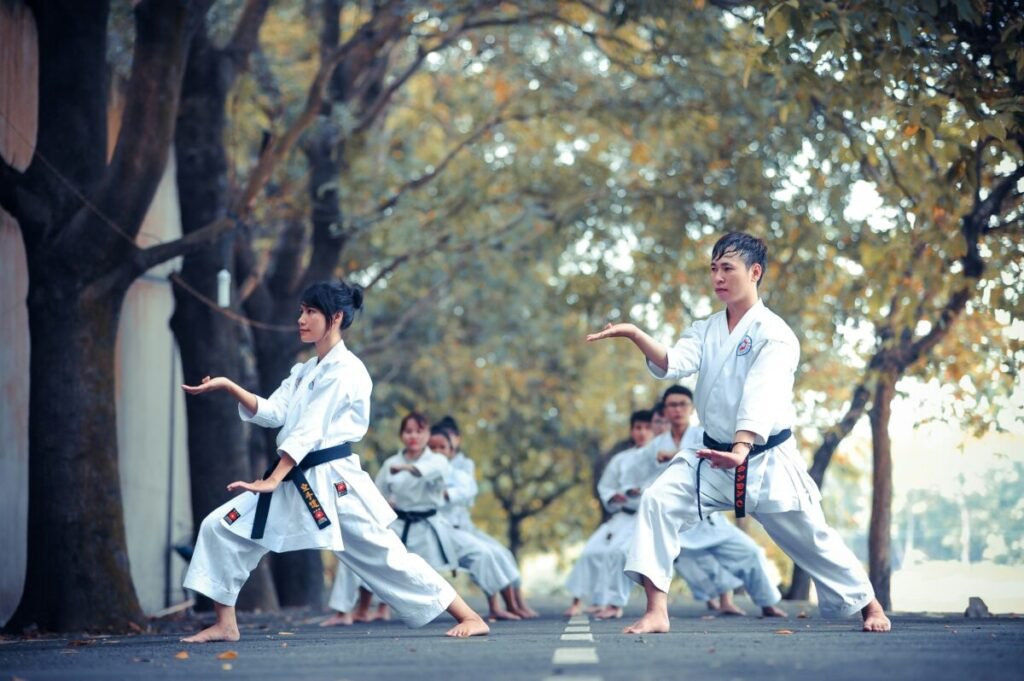

Last Tuesday, a father sat on the bench by the door at Om’s Martial Arts & Fitness Studio, his hands gripping his knees so tightly his knuckles turned white. His son, a seven-year-old with a boundless, frantic energy, was struggling to hold a static horse stance on the mat. The boy’s eyes darted everywhere—at the ceiling fans, the heavy bags, the other students—anywhere but his own feet. The father looked at me and whispered, “He just can’t stop, coach. Is he ever going to be able to focus?” I looked back at him and said, “He doesn’t need to stop; he needs a target.” That is exactly why I teach Taekwondo classes in Jaipur. If you are watching your child struggle to sit still or follow a single instruction, stop thinking of their energy as a problem to be medicated away. It is fuel. You just need the right engine to run it through.
I have spent thirty-two years teaching martial arts, and I have trained over 25,000 students. I have made plenty of mistakes along the way. Early in my career, I thought discipline meant yelling louder. I was wrong. Discipline is not about fear; it is about the quiet, repetitive work of showing up when your brain wants to be anywhere else. When you bring your child to the best martial arts academy in Jaipur, you are not signing them up for a sport. You are signing them up for a laboratory where they learn to command their own nervous system.
We are going to look at why Taekwondo is uniquely suited for kids with ADHD, moving past the common myths about physical activity. We will look at the hard science behind those kicks and blocks, and I will share stories from parents right here in our city who saw their children transform from chaotic to composed. I will also tell you exactly what to look for when choosing a fitness environment, because not all gyms are built for focus. Most importantly, we will talk about why we value discipline over motivation at our studio. Motivation is a firework—it burns bright and disappears. Discipline is the hearth—it keeps the home warm all winter.
If you are tired of the constant battle at home, take a deep breath. You are in the right place. Are you ready to see what happens when your child finally finds their target? Let’s look at why movement is the missing piece of the puzzle.
Beyond the Classroom: Why ADHD Needs Movement, Not Medication Alone
Last Tuesday, a mother sat by the mat, watching her son struggle to keep his hands still during a simple front-kick drill. She looked exhausted, the kind of tired that comes from fighting a war with homework assignments every single night. She asked me if we were wasting our time, or if Taekwondo could actually reach a brain that seems to be running on an entirely different frequency. I told her what I have learned over 32 years of teaching: your child isn’t broken, and they don’t just need to sit still. They need a different kind of input.
The science is clear, even if the classroom environment often ignores it. When your child moves—truly moves, with intention and structure—their brain chemistry shifts. That “hyper” energy isn’t a nuisance; it is a physiological signal. Research published by the NIH confirms that structured physical exertion spikes levels of dopamine and norepinephrine in the brain. These are the exact neurotransmitters that stimulant medications target. By training here, your child is essentially creating their own internal pharmacy.
Think of it as a sensory diet. If you deprive a child with ADHD of movement, you are starving their brain of the very chemicals it needs to regulate attention.
Neurotransmitters and Brain Function
| Action | Chemical Response | Resulting Benefit |
|---|---|---|
| Aerobic Martial Arts | Dopamine Increase | Improved focus and reward processing |
| Repetitive Drills | Norepinephrine Boost | Heightened alertness and executive control |
| Complex Patterns | BDNF Release | Enhanced neural plasticity and memory |
I remember a student, let’s call him Rohan. He came to me five years ago, barely able to hold eye contact and struggling with a heavy dose of stimulant medication that left him feeling like a zombie. We didn’t stop his medication overnight—that is a conversation for your doctor, not a coach. But we did commit to the mat. We focused on the discipline of the kick, the breath, and the repetition. Over eighteen months, his parents reported that his pediatrician was able to steadily lower his dosage because his “baseline” behavior had stabilized through the physical demands of our sessions. He found his own rhythm.
Do not mistake this for a miracle cure. Exercise is a powerful partner to medical intervention, not a total replacement. If you think you can skip the doctor or ignore the clinical side of things just because your child can break a board, you are setting them up for a harder path. We provide the structure that builds the neural pathways, but that doesn’t mean the medical support isn’t necessary for many.
I see parents trying to “talk” their children into better behavior all day long. You can’t lecture a nervous system into submission. If your child is struggling to focus, stop trying to use words. Use movement. Put them in an environment where the rules are firm, the physical feedback is immediate, and the goal is tangible.
When you get home tonight, look at your child. Are they vibrating with energy? That is not a flaw. That is potential waiting to be channeled into a sequence of kicks. Will you commit to bringing them to the mat three times this week, even when they say they are too tired, just to see what happens to their focus at the dinner table afterward?
The Science of Kicking: Why Taekwondo Specifically Targets Focus
Last Tuesday, a father pulled me aside near the cubbies. He was frustrated because his son, a bright kid who struggles with ADHD, kept forgetting the sequence of his first form. He asked me, “Coach, why do we make him do these repetitive patterns? Doesn’t it just bore him?” I looked at him and said, “That boredom is actually the sound of his brain building new infrastructure.”
When your child practices Poomsae—those pre-arranged patterns of movement—they aren’t just memorizing kicks and punches. They are engaging in a rigorous workout for the prefrontal cortex. Think of it as a heavy-duty cognitive load test. They have to recall the next move, maintain their balance, and watch their technique all at once. According to research on executive function, this process forces the brain to practice inhibition and working memory. It’s not just physical; it’s a mental map they are drawing in real-time.
The Mechanics of Neural Integration
You might notice your child struggles with coordination, like tripping over their own feet when they get excited. This often stems from a lack of bilateral integration. Taekwondo is unique because it forces the left and right sides of the brain to communicate constantly. When a student crosses their midline—like pulling a block across their body or shifting weight for a roundhouse kick—they are essentially “wiring” the two hemispheres together.
I’ve seen this work for over 32 years with thousands of students here in Jaipur. When the brain has to bridge that gap, focus naturally follows because the child has to be present in their body to succeed.
| Movement Type | Cognitive Benefit |
|---|---|
| Bilateral Blocks | Neural cross-talk and coordination |
| Poomsae Sequences | Working memory and sequencing |
| Target Drills | Impulse control and reaction speed |
Debunking the Myth of Repetition
Some parents worry that repetitive drills trigger an ADHD child’s tendency to tune out. They aren’t wrong—if you just stand there and repeat the same move for thirty minutes, any kid will disconnect. That is where my job as a coach comes in. I don’t believe in mindless repetition. I believe in gamified intensity.
If I see a student’s eyes glazing over during a drill, I change the target. We make it a race, or we add a “surprise” element where they have to switch kicks on my whistle. Science backs this up; studies from researchers like Ludyga and his team show that martial arts training, when done with this level of engagement, provides measurable improvements in impulse control compared to non-contact sports where the child can just “go through the motions.”
I’ve made plenty of mistakes as a coach. Early in my career, I was too rigid. I thought discipline meant silence and stillness. I was wrong. For a child with focus issues, discipline is the ability to channel that high-octane energy into a specific, controlled movement. It’s hard work, and sometimes they will want to quit when the drill gets difficult. That is exactly when you need to keep them on the mat.
Do you want to see if your child can handle the next challenge? Next time they are struggling to focus on their homework, ask them to demonstrate their form for you—but tell them they have to do it in slow motion. Watch how they have to pause, think, and engage their entire brain to keep their balance. Can they maintain that focus for the entire sequence without their mind wandering?
Discipline Over Motivation: The Om’s Martial Arts Method
Last Tuesday, a mother sat on the bench, watching her son struggle to tie his belt for the tenth time. She looked at me, frustrated, and asked, “How do you keep him coming back? He quits soccer after three weeks because he gets bored.” I looked at her and said, “We don’t rely on him being excited. We rely on the belt.”
That is the secret. Most parents think their child needs to be “motivated” to succeed. They think the child needs a spark of interest to show up. But for a kid with ADHD, interest is a fickle friend. It arrives when the dopamine hits and vanishes the moment the challenge gets dull. In my 32 years of teaching, I have learned that motivation is a mood, but discipline is a muscle. You build that muscle by making the work consistent, not just fun.
The Biological Feedback Loop
Children with ADHD often grapple with executive dysfunction. Their prefrontal cortex—the part of the brain that handles planning, impulse control, and starting tasks—needs concrete, immediate feedback to stay engaged. Team sports often fail these kids because the feedback is too slow or too complex. Did he score? Did he miss? Was the team mad? It’s overwhelming.
Taekwondo provides a different path. Our belt system acts as a real-time neuro-feedback loop. When a student earns a yellow stripe, they see the direct consequence of their specific, repetitive effort.
| Feature | Impact on ADHD Brain |
|---|---|
| Individual Progression | Removes the anxiety of “letting the team down.” |
| Repetitive Drills | Builds neural pathways for impulse control. |
| Graded Challenges | Provides dopamine hits through small, achievable wins. |
Why Rigid Methods Fail
Some instructors think discipline means yelling until a child stands perfectly still. That is not discipline; that is intimidation, and it leads to burnout faster than you can blink. At my studio, we use positive reinforcement to build habit. If a student is having an “off” day, we don’t punish them for lack of focus. We shorten the interval of the drill. We give them a target they can hit in three seconds, not thirty.
Retention data supports this. Studies suggest that martial arts programs hold onto neurodivergent students significantly longer than traditional team sports. Why? Because the goal is internal. They are competing against who they were yesterday, not against a teammate who might be faster or stronger.
The Coach’s Reality
I once tried to force a student to hold a horse stance for five minutes straight. He hated it. He started crying, and I realized I was just being a drill sergeant, not a teacher. I was confusing “discipline” with “punishment.” I changed my approach. Now, we hold for ten seconds, jump, and high-five. We repeat that. He does the same amount of work, but his brain stays in the game because the feedback is constant.
You need to stop looking for your child to be “motivated” to practice their forms. Motivation is a feeling. Discipline is a habit. You don’t wait for your child to feel like brushing their teeth; you make it a standard of the house. Treat the dojo the same way. It is a place where we show up, we bow, and we work, regardless of how we feel when we walk through the door.
Are you willing to stop asking your child if they “feel like” training and start treating their practice as a non-negotiable part of their day? Try it for one week. See if the consistency doesn’t change the way they handle the rest of their homework.
Real Stories: How Taekwondo Classes in Jaipur Changed Lives
Last Thursday, a mother named Mrs. Sharma pulled me aside right after the junior class. She looked exhausted, the kind of tired that comes from three years of fighting homework battles and teacher complaints. Her son, Aryan, had been struggling with ADHD symptoms that made sitting still feel like a physical impossibility. She told me, “Om Sir, he finally finished his math worksheet without getting up once.” That, to me, is the real victory. It’s not about the medals or the black belt; it’s about the peace of mind he brought back to his dinner table.
I have seen 25,000 students pass through these doors over the last 32 years. I know the skepticism parents bring with them. You wonder if this is just another activity to burn energy, or if it actually changes the wiring. Critics often talk about selection bias—arguing that parents who bring their kids to a dojo are already proactive, so the results are inevitable. I disagree. I’ve seen plenty of “proactive” parents fail because they look for quick fixes. Martial arts isn’t a quick fix. It is a slow, grinding process of discipline over motivation. You don’t just get better at kicking; you get better at existing in a world that asks you to be still.
Behavioral Shifts: From the Mat to the Classroom
When Aryan learns to hold a side-kick position, he isn’t just strengthening his quads. He is practicing the exact same neural engagement he needs to listen to his history teacher. We teach them to breathe, to look at a target, and to ignore the noise. That is the transferable skill. When you see a child who couldn’t focus for five minutes suddenly sit through a 45-minute school lesson, you are seeing the result of repetition.
| Skill Developed on the Mat | Application in Daily Life |
|---|---|
| Holding static stances | Sitting through class lectures |
| Following complex patterns | Completing multi-step homework |
| Controlled breathing | Managing pre-exam anxiety |
| Respecting the bow | Interacting with teachers/peers |
I’ve watched our community in Jaipur transform. It’s not just the child who changes; it’s the family dynamic. When a parent stops seeing their child as a “problem” to be managed and starts seeing them as a student who is learning to regulate their own intensity, the stress levels in the home drop. You stop hovering, and you start trusting. That shift is massive.
Listen, I’m not saying your child will be perfect tomorrow. In fact, they will probably have a bad day on the mat next week. They might lose their temper or forget a form. That’s okay. My job isn’t to make them perfect; it’s to give them the tools to handle their own imperfections. I’ve made thousands of mistakes as a coach, and I’m still learning. If I can admit that, you can afford to be patient with your child.
Look at the progress honestly. Are you seeing these small, quiet changes?
- Does your child wait for you to finish speaking before they jump in?
- Can they handle a moment of frustration without throwing their shoes?
- Do they seek out their uniform when it’s time to go, showing personal accountability?
If you see even one of these, you are winning. Don’t look for a miracle. Look for the next small step. What is one thing you will do tonight to help your child practice the focus they learned in class today?
Choosing the Right Environment: A Comparison of Fitness Options
Last Tuesday, a father walked into my office here at Om’s. He was frustrated. He’d tried everything—soccer, swimming, even a local dance troupe. He told me, “Coach, my son just runs in circles while the other kids play the game.” He was looking for a miracle. I told him the truth: there are no miracles, only environments that match the way your child’s brain processes the world.
If you are hunting for the right fit, you have to look past the shiny brochures. You need to understand how different activities tax a child’s sensory system and executive function.
Predictability vs. Social Complexity
Think of it this way: some sports are built on chaos. In soccer, the ball is always moving, teammates are shouting, and the rules shift every second. For a child with ADHD, that high-social complexity can be overwhelming. They don’t need more noise; they need a framework where they can automate their movements.
| Activity | Predictability | Social Complexity |
|---|---|---|
| Taekwondo | High | Low/Moderate |
| Soccer | Low | High |
| Swimming | High | Very Low |
| Yoga | High | Low |
Does this mean your child should avoid soccer? Absolutely not. Some ADHD children thrive in that high-octane, social-heavy environment because it keeps them stimulated. But if you see your child melting down or disengaging, stop pushing them into a square hole. Taekwondo offers a “middle path.” It is individual, yet we train in a collective. Your child learns to master their own body first. Once they have that baseline, the social interaction on the mat becomes a controlled, respectful exchange rather than a chaotic scramble.
What to Look For (And What to Run From)
When you tour a facility, keep your eyes open. I’ve been teaching for 32 years, and I’ve seen some “coaching” styles that make my skin crawl. If you see an instructor screaming at a child to “just pay attention,” leave. That is not discipline; that is a lack of professional skill.
Look for these red flags:
- The instructor ignores the kids who are struggling and only focuses on the naturally gifted ones.
- The room is so over-stimulated with loud music and constant yelling that nobody can hear a single instruction.
- The class size is so large that your child becomes a ghost in the back row.
At my studio, we keep our ratios tight. If I have thirty kids on the floor and I can’t tell you exactly what your child did well today, I have failed. Research supports this; studies show that when kids work in structured environments with multimodal cues—visual signals combined with direct, clear verbal feedback—their ability to allocate attention improves dramatically. They aren’t just “behaving”; they are learning how to manage their own motor resources.
The Tough Truth
I’ve made mistakes, too. Years ago, I tried to push a student too hard because I thought “toughness” was the only answer. I almost broke his spirit. I learned that day that discipline isn’t about crushing a child; it’s about providing the boundaries they need to feel safe enough to try.
If you bring your child to me, I will be honest with you about whether we are the right fit. You deserve a coach who values your child’s growth more than your monthly fee.
Are you looking for a place where your child is just another number, or are you ready to find an environment that actually understands how they think? Come watch a class. Don’t look at me—look at the kids. Are they focused? Are they frustrated? Are they safe? You’ll know the answer the moment you step onto the mat.
Final Thoughts
Last Tuesday, a mother sat on the bench by the door, watching her son struggle with his side-kick. He was frustrated, his eyes darting toward the clock, his body unable to stay still. I walked over, knelt down, and told him the same thing I told my first student thirty-two years ago: “Your brain is a racecar, but you’re the one holding the steering wheel.” He looked at me, took a deep breath, and executed the kick perfectly on the next try. That moment wasn’t about a trophy. It was about him realizing he could control his own energy.
You might be tired of hearing that your child just needs “more discipline.” You know they have the drive; they just need the right place to put it. I have spent three decades training over 25,000 students here in Jaipur, and I have seen enough to know that a child who cannot sit still in a chair often becomes a master of focus when you put them on a mat. It is not magic. It is hard, repetitive, sweaty work that demands every ounce of their attention.
If you are looking for a quick fix, you will not find it here. What you will find is a system that values the long game:
- Routine creates calm: Our structured environment teaches your child that predictability is a strength, not a cage.
- Physicality regulates the mind: When the body works hard, the mind is forced to clear the static.
- Respect is earned through action: We teach your child to honor their own progress, which eventually turns into a quiet, unshakable self-confidence.
I have made plenty of mistakes as a coach. I used to push too hard, thinking volume was the answer. I learned that for a child with focus issues, the quality of the connection matters more than the number of kicks thrown. At Om’s Martial Arts & Fitness Studio, we do not just teach punches; we provide a space where your child can finally stop fighting their own brain and start working with it.
Are you ready to stop managing the symptoms and start building the person? Come to the studio this week. Watch a class. Talk to the parents who were in your shoes two years ago. Do not wait for the “right time” because that time is usually just an excuse to stay in the same cycle. Bring your child in, let them step onto the mat, and let’s see what they are truly capable of when someone finally believes in their potential. What is one small step you can take today to help your child find their focus?
You Might Also Like
→

→

→

→

→