
Last Tuesday, a father sat on the bench by the mat at Om’s Martial Arts & Fitness Studio, his hands gripping his knees so tight his knuckles turned white. His son, a seven-year-old with a boundless, frantic energy, had just spent ten minutes struggling to keep his hands still during a basic bow. The father looked at me and whispered, “Coach, is he just broken?” I looked him dead in the eye and told him the truth: your son isn’t broken, he is just waiting for a set of rules that actually make sense to his body. That is why parents looking for the best martial arts academy in Jaipur keep coming to my door. They aren’t looking for a trophy; they are looking for a way to help their child find the pause button in a world that feels like a constant, high-speed blur.
I have spent 32 years teaching in this city, and I have trained over 25,000 students. I have seen the same pattern repeat itself a thousand times. A child walks in with a diagnosis or a report card full of complaints about “lack of focus,” and six months later, that same child is standing tall, breathing calmly, and executing a perfect high kick with total control. It isn’t magic. It is the result of choosing Taekwondo classes in Jaipur that prioritize discipline over motivation. We don’t just teach kicks; we teach your child how to command their own nervous system.
You might be wondering if medication is the only path forward, or if you are failing because you haven’t found the right outlet yet. I have made plenty of mistakes as a coach over the decades—I have pushed too hard when I should have listened, and I have moved too fast when a student needed a moment to breathe. I learned that martial arts provides a structure that traditional team sports simply cannot replicate. In a game of football, the chaos is the point. In Taekwondo, the movement is the tool used to sharpen the mind.
We are going to look at why your child needs specific, rhythmic movement to rewire their brain, how we handle the restlessness that keeps you up at night, and why the stories from other parents in our community prove that change is possible. I want you to stop worrying about the labels and start focusing on the next session. Are you ready to see what your child is actually capable of when they are given the right tools to channel their fire?
Beyond the Classroom: Why ADHD Needs Movement, Not Just Medication
Last Tuesday, a mother sat by the mat, watching her son struggle to stand still during the opening bow. He was vibrating with energy, his feet tapping a frantic rhythm against the floor. I walked over, handed him a focus mitt, and told him to give me ten fast, controlled punches. After the tenth, he stood perfectly still. He wasn’t being difficult; he was just under-stimulated. That is the reality I have seen for 32 years of teaching in Jaipur. Your child isn’t broken, and they don’t necessarily need more time sitting in a chair. They need to move, and they need to do it with purpose.
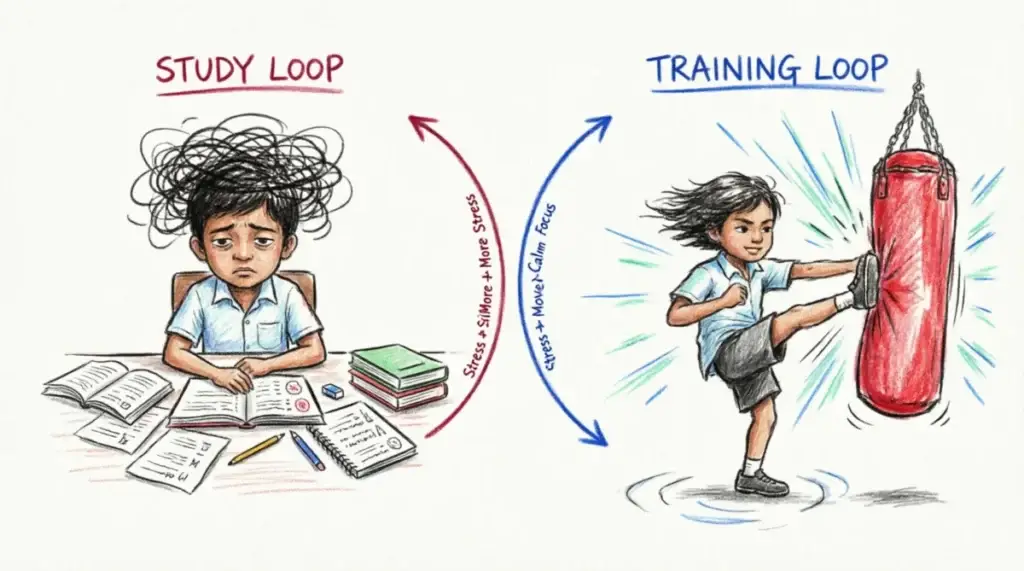
We often talk about ADHD as a problem of excess, but the research—and my own eyes—tell a different story. Scientists at the National Institutes of Health have shown that physical activity boosts dopamine and norepinephrine levels in the brain. Think of these as your brain’s natural messengers for focus and reward. When your child sits at a desk for six hours, those levels plummet. They aren’t misbehaving; their brain is literally starving for the chemical fuel it needs to pay attention. CHADD researchers suggest that what we call hyperactivity is often an unconscious attempt by the child to wake up their own brain. They move because they have to, not because they want to annoy you.
Now, let me be clear: I am a martial arts coach, not a doctor. If your pediatrician has prescribed medication, follow that advice. Martial arts is not a replacement for medical care; it is a vital, complementary tool that builds the discipline your child needs to manage their own brain chemistry. We provide a sensory diet. In a classroom, the sensory input is flat. On my mat, it is textured, rhythmic, and demanding.
The Impact of Structured Exercise
Look at the difference in how the brain handles structured movement versus idle time. When I ask a student to execute a side-kick, they must calculate distance, balance, and timing simultaneously. That is executive function in action. It isn’t just exercise; it is cognitive training.
| Feature | Classroom Environment | Martial Arts Mat |
|---|---|---|
| Primary Goal | Passive Absorption | Active Implementation |
| Sensory Input | Low/Static | High/Dynamic |
| Feedback Loop | Delayed (Grades) | Instant (Balance/Impact) |
I remember one boy, let’s call him Rohan. In his school reports, he was “distracted” and “unfocused.” When he started training with me, he couldn’t hold a stance for more than three seconds. He was constantly fidgeting. I stopped treating his movement as a nuisance and started using it. We turned his need for motion into a series of rapid-fire drills. Within six months, that same boy became one of my most disciplined students. The difference? We stopped fighting his biology and started working with it.
Data from studies tracking children aged 6-12 shows that regular aerobic exercise significantly improves scores on executive function tests. It isn’t magic; it is biology. When you give the body the movement it craves, the mind finally has the space to settle.
Stop trying to force your child to be still when their brain is begging for a signal. If you want them to focus, give them a challenge that requires their whole body to work in harmony. You have seen them struggle at home with homework, right? You have felt that frustration when they look at a page and their mind drifts away. Instead of asking them to try harder, ask them to move harder. Are you willing to trade thirty minutes of screen time tonight for thirty minutes of intense, focused movement on the living room floor? Try it and tell me if the homework doesn’t look a little easier afterward.
The Science of the Kick: How Taekwondo Rewires the Brain
Last Tuesday, a father sat on our lobby bench, watching his son struggle to remember the sequence of a basic form. He whispered, “He just can’t keep his head in the game.” I looked at him and smiled. I’ve seen that look thousands of times in my thirty-two years on the mat. The secret isn’t that his son lacks focus; it’s that his brain hasn’t been forced to build the highway for it yet.
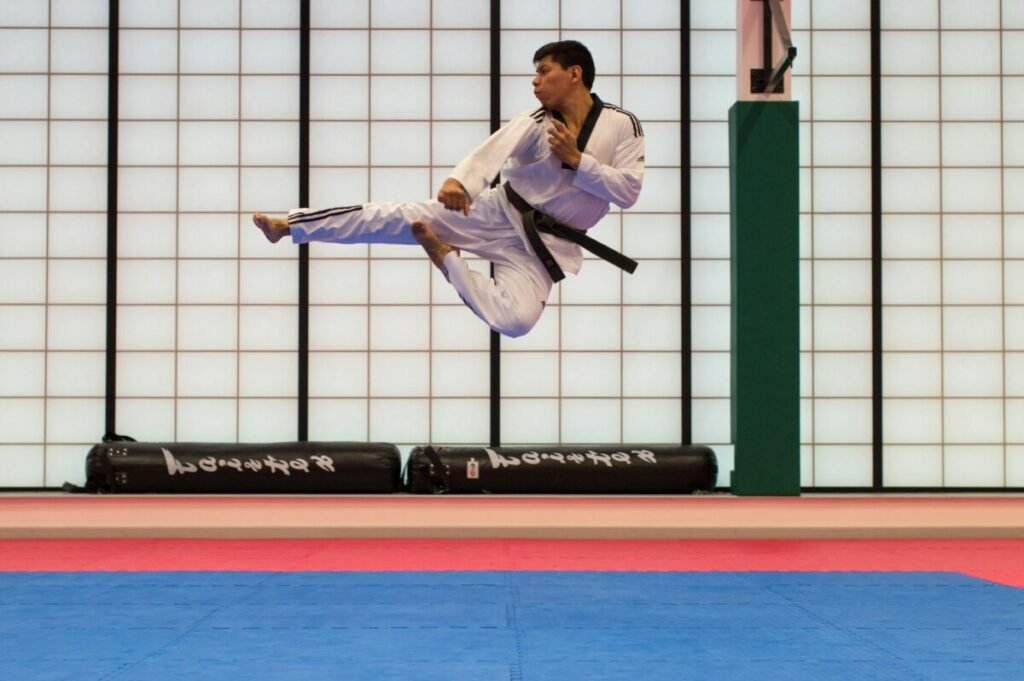
When you practice Taekwondo, you aren’t just moving limbs. You are engaging in high-level cognitive work. Unlike running or swimming, where you switch off and go on autopilot, Taekwondo demands your full presence. If you drift off, you miss the timing of the kick or lose your balance in a transition. You pay for your lack of focus immediately.
Why Poomsae is Brain Training
Think of a Poomsae—a form—as a complex puzzle written in the language of the body. You have to recall the sequence, adjust your stance, keep your hands tucked, and breathe at the right moment. This forces your prefrontal cortex to work overtime. You are training your working memory to hold multiple instructions simultaneously.
I tell my students this all the time: your brain is a muscle. If you only ever pick up light weights, you never get stronger. Simple, repetitive sports are fine for cardio, but they don’t challenge the brain to switch gears. Taekwondo forces the brain to communicate across hemispheres. Every time you cross your arms to prepare for a block or execute a kick from a deep stance, you are engaging in bilateral coordination. This cross-talk is exactly what a developing mind needs to regulate impulse control.
| Activity | Cognitive Load | Primary Benefit |
|---|---|---|
| Standard Jogging | Low | Cardiovascular health |
| Taekwondo Poomsae | High | Working memory & inhibition |
| Ball Games | Moderate | Reaction speed |
The Reality of Discipline
I have trained over 25,000 students here in Jaipur, and I’ve learned that motivation is a fleeting visitor. You cannot rely on a child “feeling” like doing their homework or focusing on a task. You build the capacity for focus through the grind of repetition.
Some parents worry their child is too “scattered” to learn these forms. That is exactly why they need to be here. I remember my own early years of training; I was restless. I wanted to move, to strike, to be loud. My master made me hold a slow, agonizingly precise stance for minutes on end. Did I hate it? Yes. Did it teach my brain to quiet the internal noise? Absolutely.
You need to stop looking at your child’s distraction as a permanent personality trait. It is a state that can be rewired. When they stand on that mat, they are learning to inhibit the urge to fidget so they can land a technique with intent. That isn’t just martial arts. That is the foundational discipline required to succeed in a classroom or a boardroom.
If you really want to see the change, watch how they handle a mistake. Do they quit? Or do they reset and try the form again? We don’t accept “good enough” here because the brain doesn’t learn from “good enough.” It learns from the correction.
Next time your child complains that the forms are “too hard,” tell them that the struggle is the point. The brain grows when it is strained, not when it is comfortable. Are you ready to stop protecting them from that productive struggle and let them build a stronger mind?
Om Sir’s Approach: 32 Years of Building Discipline in Jaipur’s Youth
Last Tuesday, a seven-year-old boy in my beginner class threw his belt on the floor after missing a side-kick three times. His face turned bright red, and he started to cry. Five years ago, I might have told him to stand in the corner and think about his behavior. Today? I walked over, picked up the belt, and handed it back to him. I didn’t scold him. I told him, “Your frustration is energy. You are using all that power on the wrong thing. Put it into your legs.” He took a breath, adjusted his belt, and landed the kick on the fourth try.
I have spent 32 years on these mats in Jaipur, and I have trained over 25,000 students. I have seen the same patterns emerge, regardless of the decade. The “old-school” way of teaching—just shouting commands until a child falls in line—often fails children with ADHD. It ignores the neurological triggers of their impulsivity. My approach has evolved. I still demand respect and total effort, but I have learned that discipline is not something you impose; it is something you build through consistent, small wins.
When researchers like Ludyga and his team examine how martial arts impacts working memory in children with ADHD, they confirm what I see every afternoon: structured physical movement acts as a reset button for the brain. It is not magic. It is biology.
The Framework of Respect
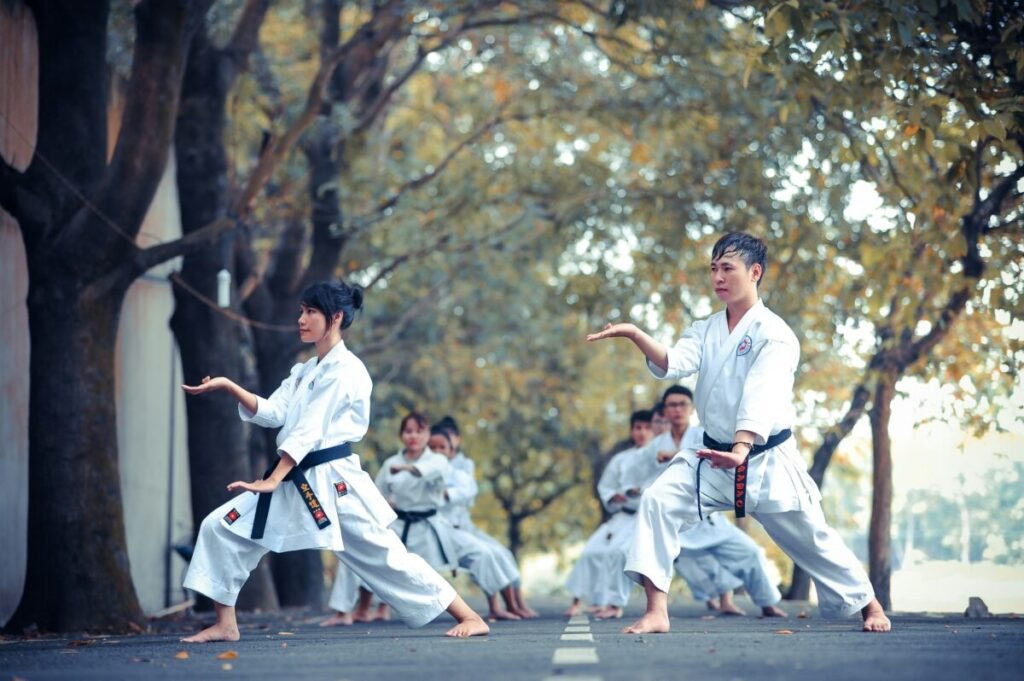
You might wonder how traditional values like integrity and perseverance help a child who struggles to sit still in a classroom. It works because we give them a clear, predictable structure. In our studio, the rules never change. When a student enters, they bow. When they finish a drill, they bow. This repetition creates a behavioral safety net.
Look at how these traditional pillars translate into real-world focus:
| Traditional Value | ADHD Behavioral Application |
|---|---|
| Respect | Learning to wait for a turn and listen to instructions. |
| Integrity | Taking ownership of mistakes without making excuses. |
| Perseverance | Training the brain to stick with a difficult task instead of quitting. |
I remember a young girl who came to me with a diagnosis of severe ADHD. Her teachers told her parents she was “unmanageable.” She spent her first three months here just learning how to stand in a ready stance without fidgeting. We didn’t push for speed; we pushed for stillness. By the end of her first year, she had achieved a level of emotional regulation that surprised her own parents. She wasn’t “fixed,” because she wasn’t broken. She simply learned how to command her own body.
Moving Past the Old Ways
Do not mistake my focus on tradition for rigidity. If I treat a child with ADHD like a machine, I lose them. We use movement breaks and visual cues to keep their engagement high. If a student is spiraling, I don’t demand they stop feeling. I demand they redirect that feeling.
Scientific studies, including the work by V. Pujari, highlight that martial arts serves as a specific tool for cognitive behavioral improvement. When your child learns to control their breathing during a high-intensity sparring drill, they are practicing the exact skill they need when they feel overwhelmed by a math test or a loud classroom.
You want your child to be more disciplined, but are you willing to let them struggle for five minutes on the mat so they can succeed for five hours at home? It is tough love, yes, but it is the kind that lasts.
What is the one thing your child finds most difficult to focus on at home, and how do you think a bit of controlled physical challenge might change their perspective on that task?
Comparing Activity Types: Where Taekwondo Outshines Traditional Sports
Last Tuesday, a mother sat on the bench in my studio, watching her son struggle to keep his eyes on the soccer ball during a weekend game video. She told me, “Om Sir, he just stands in the grass and picks daisies while the game moves past him.” I see this constantly. In team sports like soccer or cricket, the bench is a graveyard for a child with ADHD. When your child isn’t the star player, they spend the vast majority of their time waiting, watching, or getting distracted.
In my 32 years of teaching over 25,000 students here in Jaipur, I have learned one hard truth: children with focus issues need movement, not waiting.
The Bench Problem: Active vs. Passive Time
Think about the structure of a typical team sport. If your child is on a field with twenty other kids, how many seconds is that ball actually at their feet? Research on physical engagement shows a massive disparity between team-based games and individual martial arts.
| Activity Type | Active Participation | Wait/Idle Time |
|---|---|---|
| Field Sports (Soccer/Cricket) | 15-20% | 80-85% |
| Taekwondo Training | 85-90% | 10-15% |
When your child stands still for eighty percent of a game, their brain finds other things to do. They look at the clouds, they talk to the kid next to them, or they simply check out. In my studio, we don’t have benches. When you step onto the mat, you are the protagonist of your own development. You are constantly drilling, adjusting, and refining. There is no place to hide, and more importantly, there is no reason to drift away.
Feedback Loops and the ADHD Brain
Traditional coaching often involves a coach shouting instructions from thirty yards away. For a child needing immediate feedback, that distance is an eternity. When I teach, I am right there. I see your foot angle. I see your breath. I correct you the second the mistake happens. This immediate feedback loop is vital. It keeps the brain engaged in the “now” rather than wandering into the “what if.”
People often tell me, “But Om Sir, don’t they miss out on the social bonds of a team?”
That is a myth. Socializing while standing around in a field isn’t the same as the camaraderie built through shared struggle. My students learn to respect their partners because they are literally helping each other get better. They bow to each other. They hold targets for each other. That is a deeper, more intentional connection than sitting together on a bench waiting for a turn.
A Challenge for Your Week
I want you to look at your child’s current activity. Are they waiting more than they are doing? If they spend more time watching the game than playing it, you are feeding their distraction, not curing it.
Discipline isn’t about sitting still; it’s about staying focused on the task at hand until the task is complete. If you want to see if your child can handle that kind of direct, constant engagement, bring them to the mat for one session. Don’t tell me they can’t focus until you have seen them move for forty-five minutes straight without a single moment of idle time.
Are you ready to see what happens when they have nowhere to hide but behind their own best effort?
Real Stories from Jaipur Parents: Turning Chaos into Calm
Last Tuesday, a mother stood by the mat at my studio watching her seven-year-old son struggle to hold a low horse stance. He was fidgeting, his eyes darting toward the door, his legs shaking with frustration. She leaned over to me and whispered, “He just can’t sit still for five minutes at home, Om Sir. How do you keep him here for an hour?” I smiled because I’ve seen this exact scene play out for thirty-two years. The magic isn’t in a secret technique. It is in the repetition.
When you bring your child to the dojang, you aren’t just signing them up for kicks. You are signing them up for a battle against their own impulses.
Take the case of Aarav, a student who joined us eighteen months ago. His school teacher had called his parents three times in one month because he kept disrupting the class. He couldn’t wait his turn, and he certainly couldn’t focus on a single worksheet. Today, that same boy is a green belt. His father told me last week that the school reports have changed entirely. The teacher now notes that Aarav is the one helping others stay on task.
How does that happen? It is the transfer effect.
The Ripple Effect of the Dojang
The discipline we drill here—bowing to the instructor, waiting for the command to move, holding a position until the count is finished—bleeds into the rest of their lives. It does not happen in a week. It takes months. If you expect your child to stop being impulsive after three classes, you are setting yourself up for disappointment.
Progress is rarely a straight line. Some days, your child will walk onto the mat and look like a black belt in waiting. The next day, they might be back to square one, unable to stand still for ten seconds. That is not failure; that is the process.
Parental Observations Over 12 Months
I have tracked the feedback from hundreds of parents in Jaipur. Here is what they typically report after consistent attendance:
| Behavioral Metric | Initial State | After 12 Months |
|---|---|---|
| Listening to instructions | Needs 3-4 reminders | Responds on the first cue |
| Impulse control | Interrupts frequently | Waits for a break in speech |
| Task completion | Abandons after 5 minutes | Stays until the work is done |
Tough Love for the Parents
Listen, I know it is exhausting. You are tired of the phone calls from teachers and the meltdowns at the dinner table. But you must be the calm in their storm. If you react to their chaos with your own, you are only feeding the fire. Dayna Abraham talks about prioritizing your own self-care, and she is right. You cannot teach patience if you are fraying at the edges.
When your child comes home today, don’t ask them if they were “good.” Ask them if they listened to their own body. Ask them if they waited for their turn during the sparring drills.
We don’t teach martial arts to create fighters. We teach it to create people who can manage their own energy. I have trained over 25,000 students in this city, and the ones who thrive are the ones whose parents understand that consistency beats intensity every single time.
Are you ready to commit to the long haul, even when your child has a bad week on the mat? What is the one small habit you will focus on at home this evening to reinforce the focus they practiced with me today?
Final Thoughts
Last Tuesday, a mother sat on the bench near the door, watching her son struggle to hold a low horse stance. He was fidgeting, his eyes darting to the clock, his mind clearly somewhere else. I walked over, adjusted his posture, and whispered, “The fight isn’t against the stance; it’s against the urge to quit.” By the end of the session, he held that position for ten seconds longer than he did the week before. He looked at me, breathless and beaming. That wasn’t just a physical win. That was him reclaiming control over his own nervous system.
I have spent 32 years on these mats, and I have made plenty of mistakes as a coach. I used to think yelling louder would fix a lack of focus. I was wrong. Discipline isn’t something you demand; it is something you build, one kick and one breath at a time. If you want your child to find their center, you have to stop looking for a quick fix and start looking for a consistent practice. Medication has its place, but movement is the architecture of a calm mind.
Here is what you need to remember as you head home tonight:
- Consistency beats intensity every single time. Don’t worry about the perfect kick; worry about showing up when you don’t feel like it.
- Movement is brain food. Complex patterns in Taekwondo force the brain to switch gears, which is exactly what a restless mind needs to settle down.
- The belt is just a piece of cloth. What matters is the patience your child develops while waiting for that next stripe.
You might be wondering if your child is “too restless” for the dojo. My answer? That restlessness is exactly why they belong here. I have seen thousands of students walk through the doors of Om’s Martial Arts & Fitness Studio, and I have yet to meet one who couldn’t be helped by the structure of the martial arts. We aren’t here to turn your child into a robot. We are here to help them become the boss of their own energy.
Do this for yourself and your family: stop overthinking the science and start experiencing the sweat. Bring your child to the studio this week for a trial session. Let them feel what it is like to be challenged, to stumble, and—most importantly—to get back up without being told to. If you are ready to stop managing the chaos and start building a foundation of strength, we are ready to help. Will you join us on the mat, or are you going to keep watching from the sidelines?
The path to focus is waiting. I will be here, belt tied, ready to start when you are.
You Might Also Like
→
→
→

→

→