
Belt System & Rank Progression in Taekwondo — The Complete Guide from White Belt to Black Belt and Beyond
The belt ranking system is one of the most recognized aspects of martial arts training globally. For a student walking into Om’s Academy for the first time, the colored belts worn by senior students represent visible milestones of progress, discipline, and dedication. For parents watching their children train, the belt system provides a tangible way to measure growth. For advanced practitioners, the dan (black belt) ranks represent not an endpoint, but the beginning of a deeper commitment to the art of Taekwondo. Despite its universal recognition, the system remains widely misunderstood. This guide provides an honest look at the Kukkiwon and World Taekwondo (WT) curriculum followed at Om’s Academy.
The core concept is simple. In the Kukkiwon system, students hold geup (grade) ranks, numbered from 10th geup (white belt) down to 1st geup (red-black stripe). After passing a formal black belt test, the student enters the dan (degree) ranks, numbered upward from 1st dan through 9th dan. This descending-then-ascending structure mirrors the educational progression from primary school to university. Geup means class or grade; dan means level or degree. A color belt student is a yugeupja, a junior black belt holder is a yupumja, and a senior black belt holder is a yudanja. Those who reach 6th dan and above are kodanja, or high-level practitioners.
The Origin of the Belt Ranking System
Contrary to popular myth, the colored belt system is not an ancient tradition. It was created in 1883 by Jigoro Kano, the founder of Kodokan Judo. Kano introduced the concept to provide clear visual indicators of rank and to motivate students through achievable, incremental milestones. He borrowed the structure from the Japanese strategy board game Go, which uses kyu (class) for beginners and dan (level) for advanced players. In the earliest days of Judo, there were only two colors: white for beginners and black for advanced practitioners. Multiple colors were added later in the 20th century to help instructors manage larger classes and track student progress more effectively.
The system was adopted by Korean martial arts in the 1940s. The first black belts in Taekwondo were often practitioners who had already earned rank in Judo or Karate. The Kukkiwon, established in 1972 in Seoul, standardized these ranks for the modern era. Since then, it has issued over 12.3 million dan and poom certificates. The persistent legend that ancient martial artists trained until their white belts turned black from blood and dirt is entirely false. It is a romanticized invention with no historical basis; the system is a deliberate, modern administrative tool designed to foster consistency and goal-setting.
The WT/Kukkiwon Belt System: The Complete Official Syllabus
The Kukkiwon defines five core color belt levels before black belt: white, yellow, green, blue, and red. However, because there are 10 geup ranks to progress through, most schools, including Om’s Academy, utilize intermediate stripe belts to ensure a more gradual, manageable learning curve. This provides 10 distinct stages of development. While the Kukkiwon sets the global standards for dan certification, it allows individual schools flexibility in their color belt testing requirements, provided they maintain the integrity of the curriculum.
Belt Colour Symbolism: The Plant Growth Metaphor
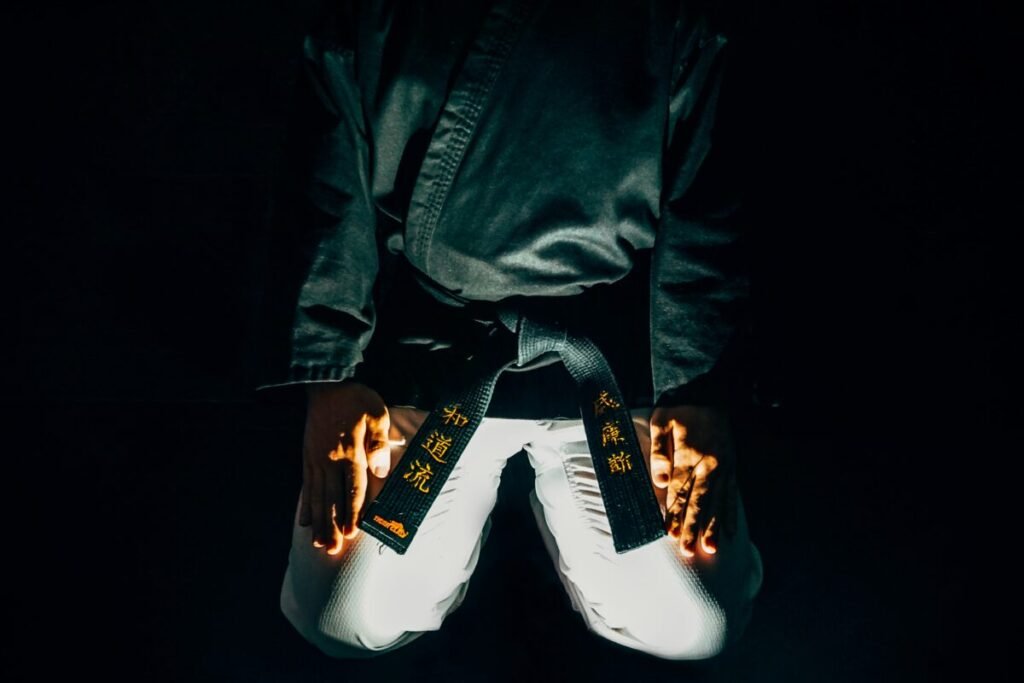
We teach our students that martial arts growth, like nature, is a process that cannot be rushed. The white belt is the seed beneath the snow—pure and ready to learn. The yellow belt is the earth where the seed takes root. The green belt represents the plant sprouting upward, while the blue belt signifies the sky toward which it reaches. The red belt is the ripening fruit, carrying a warning of danger; the student now possesses significant power and must exercise extreme control. The black belt signifies maturity and the overcoming of ignorance. At Om’s Academy, we emphasize that discipline over motivation is the key; a black belt is not the finish line, but the point where the student truly begins to understand the art.
Complete Belt Progression Table
The following table outlines the Kukkiwon-standard progression. At Om’s Academy, we utilize these benchmarks to ensure every student masters the foundational mechanics before moving to more complex forms.
| Geup | Belt Colour | Korean Term | Symbolism | Poomsae |
|---|---|---|---|---|
| 10th | White Belt | Huin Tti | Purity, beginning | Kibon Poomsae |
| 9th | White-Yellow Stripe | Huin-Norang Tti | Foundation forming | Preliminary Poomsae |
| 8th | Yellow Belt | Norang Tti | Earth, roots | Taegeuk Il Jang |
| 7th | Yellow-Green Stripe | Norang-Chorok Tti | Growth beginning | Taegeuk Ee Jang |
| 6th | Green Belt | Chorok Tti | Developing skills | Taegeuk Sam Jang |
| 5th | Green-Blue Stripe | Chorok-Pureun Tti | Reaching upward | Taegeuk Sa Jang |
| 4th | Blue Belt | Pureun Tti | Sky, aiming higher | Taegeuk Oh Jang |
| 3rd | Blue-Red Stripe | Pureun-Balgan Tti | Maturity approaching | Taegeuk Yuk Jang |
| 2nd | Red Belt | Balgan Tti | Danger, control | Taegeuk Chil Jang |
| 1st | Red-Black Stripe | Balgan-Heuk Tti | Final preparation | Taegeuk Pal Jang |
What Each Belt Level Demands: Skills and Expectations
Om Sir, with over 32 years of experience training more than 25,000 students, emphasizes that grading is not just about memorizing sequences. It is about character. During a test, we evaluate poomsae for rhythm and precision, kyorugi (sparring) for tactical application, and gyeokpa (board breaking) for focus. Most importantly, we observe attitude. Do you show courtesy to your partners? Do you demonstrate integrity when the instructor isn’t looking? These qualities define a true martial artist.
White Belt (10th and 9th Geup): The Foundation
The white belt period is about unlearning bad habits and building a base. You will master basic stances like ap kubi seogi (front stance) and fundamental blocks. We focus heavily on the mechanics of the ap chagi (front kick). Accuracy at this stage prevents injury later. You aren’t just learning to punch; you are learning how to align your entire body to generate force from the ground up.
Yellow Belt (8th and 7th Geup): Laying the Roots
Here, you encounter Taegeuk Il Jang. This is the first time you must link 18 distinct movements into a singular flow. You will also begin the dollyo chagi (roundhouse kick). This kick is the bread and butter of Taekwondo. At this level, students often struggle with balance; we encourage you to use the dojang mirrors not to look at your reflection, but to check your chambering and foot positioning.
Green Belt (6th and 5th Geup): The Plant Grows
Sparring is introduced in earnest. You will learn that sparring is not a street fight; it is a conversation between two people testing their timing and distance. We introduce the yop chagi (side kick), which requires significant hip flexibility. If you are struggling with your flexibility, this is the time to commit to a daily stretching routine outside of class hours.
Blue Belt (4th and 3rd Geup): Reaching for the Sky
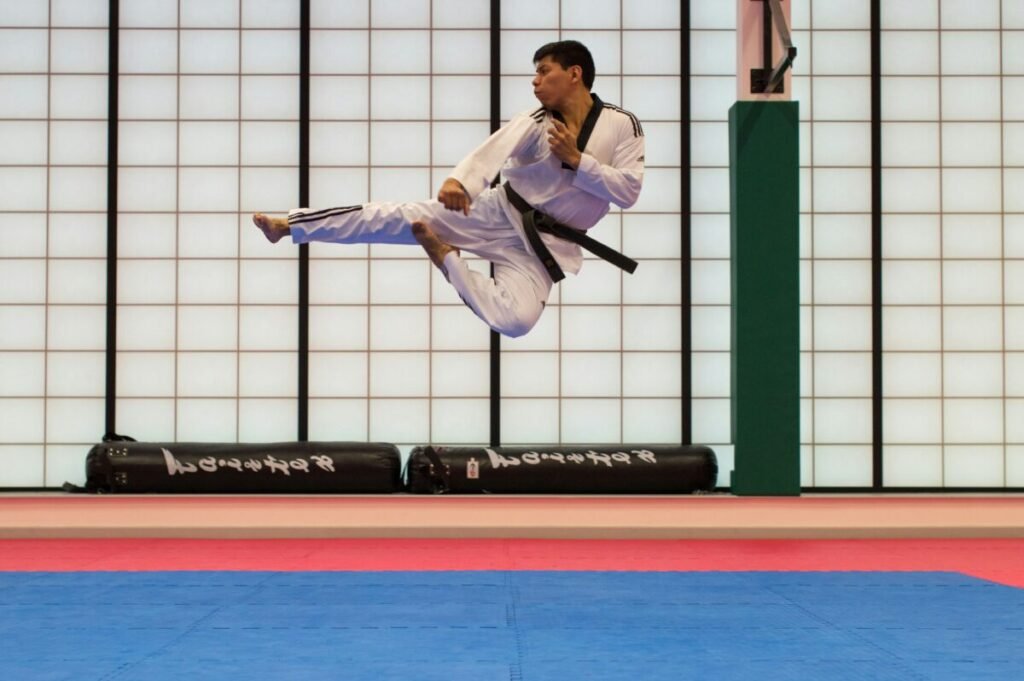
This is where the art becomes demanding. We introduce jumping kicks and more complex footwork patterns. Your sparring should now move beyond “tag” and into tactical counter-attacking. You should be able to identify an opponent’s opening and respond without hesitation. This level requires mental agility as much as physical speed.
Red Belt (2nd and 1st Geup): The Threshold of Mastery
The red belt is a high-pressure rank. You are expected to demonstrate expert-level control. We introduce spin kicks and advanced board breaking. At Om’s Academy, our red belts assist in teaching beginners. Teaching someone else is the fastest way to solidify your own knowledge. If you can explain the mechanics of a block to a child, you truly understand it yourself.
The Poom System: Junior Black Belt Explained
The poom system is designed for students under 15. The belt is half-red and half-black. It recognizes that while a child may have the physical capacity to perform the techniques of a 1st dan, they may lack the life experience required for the full adult rank. This system ensures that when a student finally dons the full black belt at 15 or older, it represents a standard of maturity as much as technical prowess.
Dan Ranks: The Black Belt Journey
A 1st dan black belt is merely a license to learn. The Kukkiwon divides dan ranks into three tiers: Trained Student (1st-3rd dan), Master Instructor (4th-6th dan), and Grand Master (7th-9th dan). The title Sabeomnim (Master Instructor) requires not just technical skill, but a proven track record of teaching and contributing to the art. Be wary of anyone who demands these titles; true mastery is signaled by humility and the ability to simplify complex movements for others.
Poomsae Progression: Forms Through the Ranks
Forms are the DNA of Taekwondo. They preserve the history of the art. From the 8 Taegeuk forms to the Yudanja series (Koryo through Ilyeo), each form challenges a different aspect of your physiology. Koryo, the first black belt form, requires a level of poise that separates the novice from the practitioner. Hansu, the 8th dan form, is often called the most demanding, requiring an effortless flow that can take decades to refine.
WT vs ITF Belt System: Key Differences
While both WT and ITF share Korean roots, they diverge in execution. WT (the Kukkiwon standard) focuses on Olympic-style efficiency, using electronic scoring and emphasizing speed. ITF utilizes the “sine wave” motion—a down-up-down movement—to generate power. If you are training at Om’s Academy, you are following the Kukkiwon path, which is the internationally recognized standard for competition and official certification.
Timeline to Black Belt and Beyond
How long does it take? If you train two to three times a week with absolute consistency, you can expect to reach 1st dan in three to five years. Some students move faster; some take longer. It does not matter. What matters is the 32 years of experience Om Sir brings to the floor to ensure you are ready when you test. We do not hand out belts. You earn them. When you stand on that mat, you aren’t just wearing a piece of fabric; you are wearing the result of every hour of sweat, every frustrated practice session, and every moment of discipline you chose over comfort.
Taekwondo is a lifestyle. It is about building a foundation that lasts for your entire life, not just for the next grading. Keep showing up, keep refining your basics, and the rank will follow.